Levy on Castles and Penthouses to Fund Hospitals and Schools - The McMansion Tax
13th January 2026
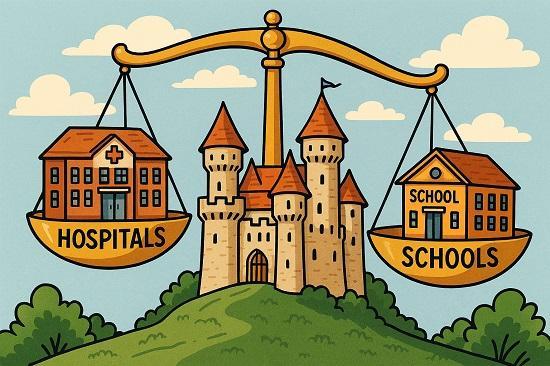
From feudal Scotland's stone fortresses to today’s glass‑walled penthouses, property has always been a marker of privilege.
The new mansion tax proposed in the Scottish budget is not just a fiscal measure—it is a reckoning with centuries of imbalance. For too long, wealth has perched on the battlements while ordinary families have struggled in the shadows below.
From Feudal Castles to Modern Penthouses
In medieval times, castles symbolized power, defended by walls that kept common folk out.
Today, luxury flats in Edinburgh or Highland estates serve the same function: fortresses of exclusivity, inaccessible to the majority.
The mansion tax is a modern battering ram, designed to breach those walls—not to destroy, but to redistribute.
Hospitals and Schools as the New Commons
Where once the commons meant grazing land, today it means public services: the NHS, classrooms, libraries.
These are the spaces where ordinary Scots gather, learn, heal, and build futures.
Yet they are starved of funds, while wealth accumulates in bricks and mortar at the top end of the market.
A Moral Argument, Not Just a Fiscal One
The levy is framed as fairness: those with castles and penthouses should shoulder more of the burden.
It is not envy, but equity. The tax is a recognition that privilege carries responsibility.
Every pound raised from high‑value properties is a pound that can shorten waiting lists, repair classrooms, and strengthen communities.
Anticipating the Counter‑Attack
Critics will cry foul: "This punishes success," “It will drive investment away.”
But history teaches us that unchecked privilege corrodes societies. From the Clearances to the slum tenements, Scotland has seen what happens when wealth is hoarded and responsibility shirked.
The mansion tax is not a penalty—it is a corrective, a rebalancing of scales tilted for generations.
A Citizen’s Checklist
High‑value homeowners: Expect to contribute more.
Middle earners: Benefit from raised thresholds.
Communities: Anticipate stronger hospitals, better schools, and renewed investment in public life.
This is Scotland’s chance to turn symbols of privilege into engines of solidarity. Castles and penthouses may glitter, but hospitals and schools are the true foundations of a nation. The mansion tax is not just about revenue—it is about rewriting the social contract, ensuring that the walls of privilege no longer stand taller than the needs of the people.