Why Caithness Distilleries Could Be Vulnerable To More Trump Tariffs
18th January 2026
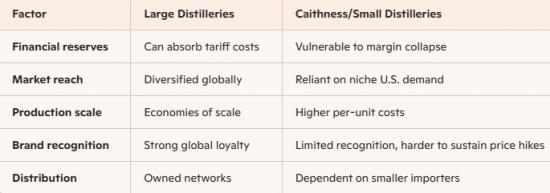
Export dependence
Scotch whisky is Scotland's largest export, with the U.S. being a £1 billion market. Even small Caithness distilleries often target niche American buyers who value single malts. Tariffs directly reduce competitiveness.
UK exports to the U.S.
10% tariff on all goods starting February 1, 2026.
25% tariff from June 1, 2026, unless Greenland is sold to the U.S. (Trump's stated condition).
Past precedent
The 25% U.S. tariff on single malts (2019-2021) cost the industry an estimated £600 million in lost sales. Smaller distilleries were hit hardest, as they couldn't offset losses with other markets.
Risks & Trade-offs
Economic strain: Tariffs could force Caithness distilleries to reduce exports or exit the U.S. market.
Community impact
Whisky is tied to rural jobs and tourism; reduced sales ripple through local economies.
Strategic shift
Distilleries may pivot to EU and Asian markets, but rebuilding brand presence takes time.
Limited resilience
Unlike giants such as Diageo, Caithness distilleries don't have diversified global distribution networks. A tariff shock risks cutting them out of the U.S. market altogether.
Value erosion
Tariffs dent the value of exports even if demand remains steady. Boutique distilleries may still sell whisky, but at lower margins, reducing reinvestment capacity.
Caithness distilleries are at risk. Tariffs don't eliminate demand for Scotch whisky, but they erode profitability, and smaller producers in regions like Caithness lack the buffers to withstand prolonged shocks.
Key Distilleries in Caithness
Wolfburn Distillery (Thurso)
The northernmost distillery on the Scottish mainland.
Produces small-batch single malts, heavily reliant on export markets like the U.S.
Vulnerable because boutique single malts are niche and price-sensitive under tariffs.
Old Pulteney (Wick)
Larger than Wolfburn but still relatively small compared to giants like Diageo.
Old Pulteney Distillery (Wick, Caithness) → produces the "Maritime Malt."
Parent company: Inver House Distillers, which also owns other Scotch brands like Balblair, Knockdhu (AnCnoc), Speyburn, and Balmenach.
Ultimate owner: ThaiBev, a major Southeast Asian drinks conglomerate.
U.S. tariffs would raise bottle prices, risking reduced competitiveness against bigger brands.
Dunnet Bay Distillers
Famous for Rock Rose Gin, but expanding into whisky.
As a newer player, they lack established U.S. distribution networks, making tariffs a major barrier to entry.
Why They're at Risk
Export reliance: All three depend on international sales, with the U.S. a premium market.
Small scale: Higher per-unit costs mean tariffs hit margins harder.
Brand recognition gap: While respected among whisky enthusiasts, they don't have the global pull of Glenfiddich or Johnnie Walker to sustain higher prices.
Distribution fragility: Smaller import partners may drop them if tariffs make sales unprofitable.
Local Impact
Jobs
These distilleries support rural employment in Thurso, Wick, and Dunnet. Tariffs could slow hiring or expansion.
Tourism
Whisky tourism is a growing part of Caithness's economy. Reduced exports may force distilleries to lean more on visitor centres and local sales.
Community resilience
Unlike giants, these distilleries are deeply tied to local identity, so tariff shocks ripple through the wider community.
Bottom line
Caithness distilleries like Wolfburn, Old Pulteney, and Dunnet Bay are at risk because tariffs erode their ability to compete in the U.S. market. Larger brands can absorb the hit, but boutique producers in Caithness face real pressure on margins, exports, and local jobs.
Trump's Tariff Regime — What, When and Why
In 2025 and early 2026, the United States under President Trump introduced a series of tariffs on imported goods from numerous trading partners. These are part of a broader strategy the administration has described as "reciprocal tariffs" and efforts to reduce trade deficits, protect U.S. industries and, in some cases, as political leverage in disputes with allies.
The main components of this tariff regime include
1. Baseline 10% “Reciprocal” Tariff (Effective 5 April 2025)
On 2 April 2025, the U.S. announced a new Executive Order imposing a baseline 10% tariff on almost all imported goods entering the United States.
This tariff took effect from 5 April 2025 and applies to most countries unless specific exemptions or trade deals alter it.
For the UK, this means that most goods exported to the U.S. face a 10% tariff on top of any normal customs duties.
This 10% tariff forms the foundation of Trump’s tariff strategy — a broad levy applied globally rather than targeted only at specific products.
2. Additional Tariffs on Specific Products (Beginning Early 2025)
a. Steel and Aluminium — 25% (12 March 2025)
A 25% tariff on steel and aluminium imports from around the world (including the UK and EU) was reintroduced by the U.S. on 12 March 2025.
This includes not only pure steel and aluminium but many derivative products as well.
b. Automobiles and Parts — 25% (Early April/May 2025)
Beginning 3 April 2025, a 25% tariff was imposed on passenger vehicles and light trucks imported into the U.S.
This was followed by the same rate on automotive parts on 3 May 2025.
These tariffs target sectors where the U.S. has persistent trade deficits and are designed to protect domestic manufacturing.
3. Higher “Reciprocal” Tariffs for Some Countries (From 9 April 2025)
From 9 April 2025, individual “reciprocal” tariffs were to come into effect, raising rates above the baseline 10% for some countries with which the U.S. has large trade imbalances.
For example, the European Union was set to face up to 20% tariffs on many goods under this system (though some of these higher rates were temporarily eased).
The UK has generally remained at the 10% baseline rate, with higher tariffs on specific products like steel, aluminium and cars.
Note: A 90-day pause on some of the higher country-specific tariffs was agreed in 2025, but the baseline 10% tariff continued.
4. New 2026 Tariffs Over Greenland Dispute (Starting 1 February 2026)
In January 2026, President Trump announced a new set of tariffs on European allies — including the UK — in connection with his push to acquire Greenland. Under this plan:
10% tariff on all goods from Denmark, Norway, Sweden, France, Germany, the UK, the Netherlands and Finland — starting 1 February 2026.
This tariff is set to rise to 25% on 1 June 2026 unless a deal over Greenland is reached.
This measure is controversial and aimed at pressuring NATO allies, not explicitly economic policy, though its stated rationale is national security.
5. Exemptions and Trade Deals
Some tariffs have been modified through negotiations or trade deals:
In May 2025, the U.S. and the UK signed a trade framework that reduced or waived some of the 25% tariffs on UK steel, aluminium and cars, replacing them with more favourable terms (e.g., a 10% rate on a quota of UK car exports).
This means that under the deal, certain UK exports face lower tariffs than the default regime.
These negotiated changes show that tariff levels are not always fixed and can be adjusted through formal agreements.
6. Why These Tariffs Were Introduced
The Trump administration has justified these tariffs on several grounds:
To reduce the U.S. trade deficit with major partners.
To protect American industry and jobs, particularly in steel, aluminium and automotive sectors.
As leverage in geopolitical disputes, such as the Greenland tariff threats.
Critics argue these tariffs violate World Trade Organization (WTO) principles and invite retaliation. For instance, the EU has considered coordinating retaliatory measures, though some were suspended under negotiated deals.