Scottish Government Caught Between A Rock And A Hard Place - rising spending commitments and limited fiscal levers
31st January 2026
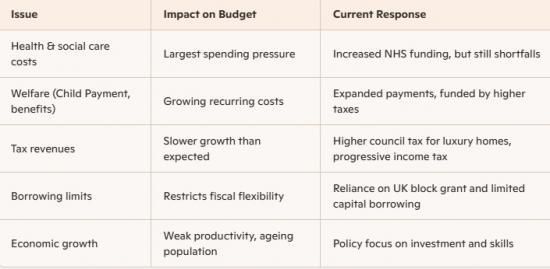
The Scottish Government is currently grappling with a tight fiscal outlook marked by rising public service costs, limited tax revenues, and constraints on borrowing powers.
The biggest issues are funding pressures in health and social care, the cost of welfare commitments like the Scottish Child Payment, and balancing devolved tax powers with UK-wide fiscal rules.
Life for Scottish Government was always going to get harder as they gradually took over responsibility for taxes and social security the two biggest government departments. With more to come on these front it will not get easier as along with new powers comes much greater running costs.
Key Financial Issues Facing the Scottish Government (2026)
Public Service Pressures
Health and Social Care: NHS Scotland faces rising demand due to an ageing population, workforce shortages, and inflation in medical costs. This is the single largest budget item and continues to grow faster than revenues.
Education & Local Government: Councils are under strain, with debates over council tax reform and funding shortfalls for schools and social services.
Tax Revenues and Fiscal Autonomy
Income Tax Divergence: Scotland has introduced higher rates for top earners compared to the rest of the UK, but revenue growth is slower than expected.
Council Tax Reform: Homes worth over £1 million are facing higher bills, but this measure raises limited revenue compared to overall spending needs.
Land and Business Taxes: Efforts to expand devolved tax bases remain constrained by economic growth.
Welfare Commitments
Scottish Child Payment: Expanded support for low-income families is politically popular but adds significant recurring costs.
Social Security Devolution
New responsibilities transferred from Westminster (e.g., disability benefits) increase spending obligations without equivalent revenue flexibility.
Borrowing and Fiscal Rules
Limited Borrowing Powers
Unlike full sovereign governments, Scotland cannot borrow extensively for day-to-day spending. Borrowing is capped and mainly for capital projects.
Dependence on UK Block Grant: Around two-thirds of Scotland's budget still comes from the Barnett formula, meaning UK fiscal policy directly impacts Scottish finances.
Economic Growth Challenges
Slow Growth Outlook - The Fraser of Allander Institute notes weak productivity and demographic pressures (shrinking working-age population) as long-term risks.
Inflation and Interest Rates
Rising costs for public sector wages and infrastructure projects squeeze available funds.