At a Standstill? UK Productivity Falters Amid Sluggish Growth
18th February 2026
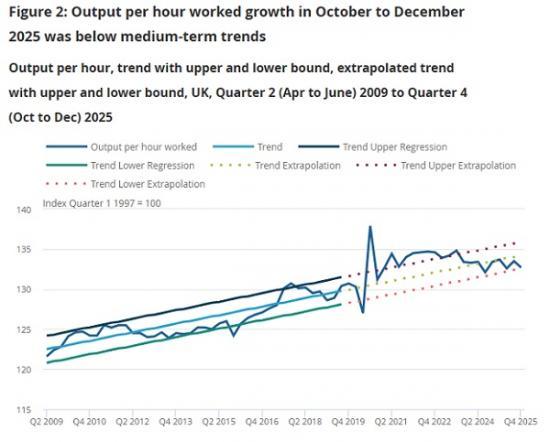
The most recent productivity figures from the Office for National Statistics (ONS), covering the final quarter of 2025. It paints a mixed picture of the UK's productivity performance, highlighting both progress relative to pre-pandemic levels and slowing momentum compared with recent quarters.
Output per Hour Falls Year-on-Year
In the three months to December 2025, the ONS's "flash estimate" indicates that labour productivity — measured as output per hour worked — fell by about 0.5% compared with the same quarter a year earlier, while output per worker dropped roughly 0.2%. This weakening reflects a situation where the number of hours worked grew faster than the increase in output, meaning workers on average produced slightly less in the quarter compared with a year ago.
At the same time, productivity remains above its pre-COVID (2019) level. Output per hour worked was around 2.4% higher than in 2019, and output per worker was around 1.9% higher. These figures signal that the economy has recovered some ground lost during the pandemic, but the pace of improvement has slowed in recent quarters.
Alternative Data Methods Show Stronger Growth
There are important methodological nuances behind these headline figures. In addition to traditional data from surveys such as the Labour Force Survey (LFS), the ONS also produces experimental productivity estimates using administrative sources like Pay As You Earn (PAYE) Real Time Information (RTI). When using these alternative methods, the data show stronger growth, with output per hour and output per worker both rising more significantly than in the LFS-based estimates.
This divergence reflects differences in how labour inputs and employment are measured, and the ONS has signalled that it plans to consult users on potentially moving to RTI-based measures as a lead indicator in future releases.
Industry Patterns and Longer-Term Context
The release also includes some insights into sectoral behaviour in earlier quarters — for example, for July-September 2025 — where industries such as information and communication made positive contributions to productivity, while financial and insurance activities detracted from it.
Taken together, these productivity estimates continue to sit within the broader backdrop of a subdued UK economy: GDP growth in the final three months of 2025 was modest, and services — which make up the bulk of UK output — showed only limited dynamism.
Interpreting the Productivity Puzzle
Despite some positive signs relative to pre-pandemic levels, the recent decline in productivity compared with a year earlier underscores the persistent "productivity puzzle" that has challenged the UK economy for much of the past decade. Progress has been uneven and slower than in many other advanced economies, a trend that appears to have carried into 2025 even as the broader labour market remained relatively tight and employment held up.
Looking Ahead
The latest flash estimates signal that productivity growth is not yet robust, and highlight the importance of improvements in economic output and efficiency if long-term growth and wage gains are to be sustained. With the ONS planning further methodological work and future quarterly updates due in May 2026, analysts and policymakers will be watching closely to see if this slowdown persists or if productivity begins to regain pace.
Read the ONS report HERE