Artificial intelligence: big thinking, practical learning and what it means for our businesses
24th February 2026
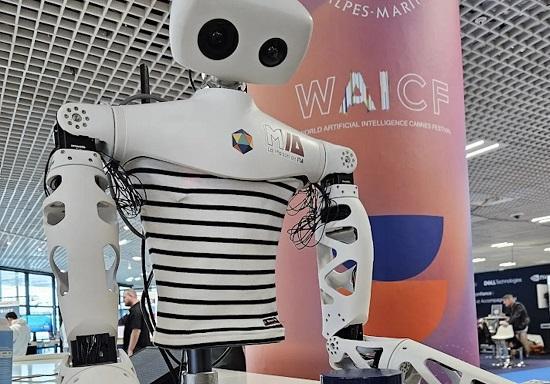
From robots to real business impact: April Conroy, HIE development manager for life sciences and the blue economy, reflects on WAICF and what human centred AI means for businesses.
ust over a week ago, I was at the World AI Cannes Festival (WAICF) alongside a delegation of 25 Scottish business leaders, as part of the Scottish Government's National AI Adoption Programme.
The scale was incredible: more than 300 international speakers, 250+ sessions, 220 exhibitors, four stages running in parallel, two demo zones and an exhibition space packed with robots, platforms, prototypes and big ideas.
But what struck our Highlands and Islands delegation most wasn't just the technology. It was the tone.
Alongside the technical insight, there was something more reflective and philosophical. Conversations about humanity, independence and creativity: including (appropriately, given we were in France) advocacy for AI as a creative force from pioneering electronic composer and performer Jean-Michel Jarre.
A recurring theme across the conference was governance, sovereignty and trust. For our businesses, particularly those operating in health, climate and data-driven sectors, that focus on responsible adoption is critical.
Buzz phrases included ‘human-in-the-loop', Agentic-AI, and the move away from LLM and toward Small-Language-Model (SLMs) in many corporate settings.
Practical business learning
For many in the delegation, the value was immediate and tangible. David MacDonald of Atlantic 58 in Stornoway described it as a massive learning curve:
"As a small SME starting to use AI, coming to a conference of this size there were always going to be big learning points - governance, sovereignty, AI workforces. The most beneficial session for me was AI for Good and seeing where it can practically make a difference."
CJ Macleod of Caledonian Climate Partners, delivering peatland restoration projects across Scotland, highlighted how AI is already improving internal processes and report quality for clients. And helping them make better use of environmental data.
There was something equally valuable: peer connection.
The exhibit area allowed our clients to find suppliers serving their sector and to see examples of new-startups paving the way for new solutions. They had access to global companies such as AstraZeneca, Mercedes-Benz and Mastercard. New relationships formed. The delegates shared learning and gained confidence.
And a recurring piece of advice: start small. Build solid foundations. Then scale.
That message is particularly relevant for businesses in our region. AI adoption doesn't require massive teams or large budgets. It often begins with small, focused applications that improve productivity, reduce admin or enhance decision-making.
Humanity: AI at the speed of life
There were sessions packed with insight on generative AI, automation and productivity. One speaker from the Human Technology Foundation made a comment that stayed with me. Many companies aren't cutting headcount as a result of AI. Instead, staff are making "micro-gains" in productivity - what he jokingly called "dog time". Saving time here and there, and using it to reclaim small parts of their day.
What does that tell us about humanity? Alan White of Inverness-based Wristbud captured this beautifully:
"A keynote speaker suggested that rather than evolving at the speed of light, AI might be better understood as developing at the speed of life, with humanity and trust as its foundations."
That's especially important in digital health. Angus Perry of CIEL Healthtech Ltd, a GP in Evanton building AI tools for primary care, reflected:
"Anyone can incorporate AI into their products now, that's no longer a USP. The real intrinsic value is using small language models. You can build better products that are faster, lower cost, lower energy and more accurate."
For Angus, the biggest takeaway wasn't hype. It was reframing how AI is built: smaller, more efficient, more focused models that solve specific problems well.
That's practical. It’s usable. And it aligns with responsible adoption.
The bigger picture for the Highlands and Islands
We returned from Cannes inspired, but also grounded.
Yes, the robots were impressive.
Yes, the scale was global.
Yes, the energy was contagious.
But the most important takeaway was this:
AI is no longer about access. Everyone has access. The real advantage lies in how thoughtfully, efficiently and responsibly we use it.
For businesses in the Highlands and Islands, the opportunity is clear. AI can help address skills shortages, improve productivity, strengthen competitiveness and open up new markets IF adopted in the right way.
At HIE, we’re clear that sustainable, responsible adoption should sit alongside innovation. AI does have environmental impacts in terms of energy use, but it also offers real potential to support net zero - improving efficiency, reducing waste and helping businesses lower emissions.
If you’re curious about what AI could mean for your business, whether you’re exploring first steps or already developing solutions, we’re here to help demystify it and support practical adoption.
Let’s keep the conversation going.
April Conroy
Senior development manager life sciences and blue economy
April is HIE's senior development manager for life sciences and the blue economy.
Related Businesses
Related Articles