Young people not in education, employment or training (NEET), UK: February 2026
1st March 2026
Estimates from January to March 2025 include the full effect of the improvements in Labour Force Survey (LFS) data collection and sampling methods introduced from January 2024; however, estimates may be subject to the effect of further ongoing improvements.
An increased amount of volatility will remain in the estimates from mid-2023 and throughout 2024, so we would advise caution when interpreting change involving those periods.
Estimates such as young people not in employment, education or training (NEET) will likely continue to see greater volatility than more aggregated measures because of smaller population subgroups compared with the headline rates, despite improved sample sizes.
LFS estimates are weighted to 2022 mid-year population estimates for periods from January to March 2019; the number of young people aged 16 to 24 years not in education, employment or training (NEET) estimates have a discontinuity at this point.
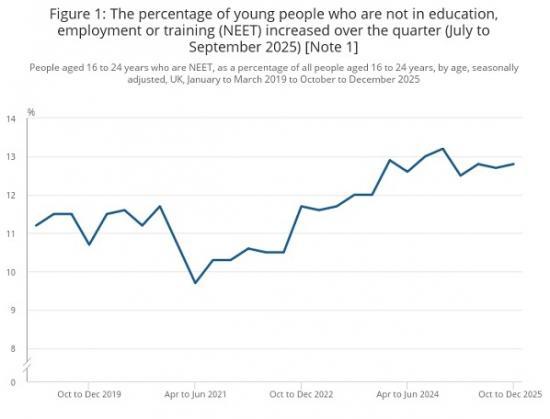
There was an increase in the number of young people aged 16 to 24 years who were NEET in October to December 2025; the total is currently estimated to be 957,000, up from 946,000 in July to September 2025.
Total young people who were not in education, employment or training (NEET)
An estimated 12.8% of all people aged 16 to 24 years in the UK were not in education, employment or training (NEET) in October to December 2025. This is up 0.1 percentage points compared with July to September 2025, and down 0.4 percentage points on the year.
An estimated 13.3% of young men (down 0.1 percentage points on the quarter) and 12.2% of young women (up 0.3 percentage points on the quarter) were NEET.
There were 957,000 young people who were NEET in total, an increase of 11,000 on the quarter. This increase was largely caused by young women, with an increase of 13,000 on the quarter, while young men saw a decrease of 2,000. Of the total number of young people who were NEET, 510,000 were young men and 448,000 were young women.
The total number of people aged 18 to 24 years who were NEET was 891,000, up 11,000 on the previous quarter.
The percentage of all those aged 18 to 24 years who were NEET was 15.2%, which again was up 0.1 percentage points on the quarter and down 0.3 percentage points on the year.
Unemployed young people who were not in education, employment or training
There was an estimated 411,000 young people NEET aged 16 to 24 years who were unemployed in October to December 2025. This was up 45,000 from July to September 2025, and up 19,000 from October to December 2024.
An estimated 266,000 of these unemployed young people NEET were young men, and 145,000 were young women. The number of NEET men aged 16 to 24 years who were unemployed increased by 28,000 from July to September 2025, while the number of NEET women aged 16 to 24 years who were unemployed increased by 17,000 on the quarter.
Economically inactive young people who were not in education, employment or training
There were an estimated 547,000 economically inactive young people aged 16 to 24 years who were NEET in October to December 2025. This was down 34,000 on the quarter from July to September 2025, and down 33,000 on the year from October to December 2024.
The number of young men who were NEET and economically inactive was 244,000 and the corresponding number of young women was 303,000. The total decrease of 34,000 on the quarter was largely caused by young men, who saw a decrease of 30,000 from July to September 2025, while young women aged 16 to 24 years who were NEET and economically inactive decreased by 3,000.
Read he full ONS report HERE