Highland Council agrees 2026-27 budget including £12 million of new investments
6th March 2026
The Highland Council has agreed its budget for 2026-27, setting out plans for new investment in key services, actions to support sustainable growth across the region, and targeted support for those who need it most.
The budget includes:
A 7% increase in Council Tax - 5% to support the delivery of core services like education, roads, housing and social care, and 2% of ring-fenced funding for The Highland Investment Plan, the Council's £2.1 billion, 20-year programme of capital investment in schools, infrastructure, and community facilities.
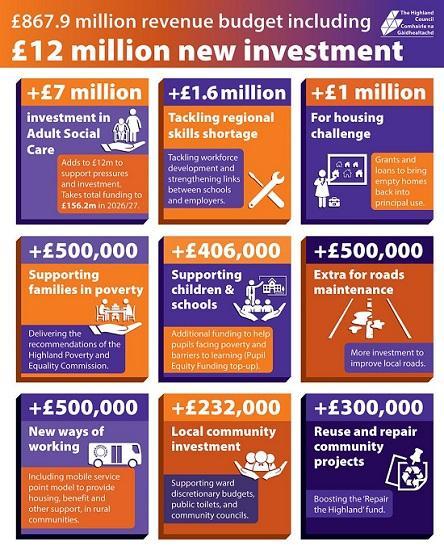
£12 million of new investment in adult social care, housing, education, regional skills, poverty reduction, and roads. This adds to £4.5 million of recurring investment previously agreed from last year's budget setting process.
A £61 million package of strategic and service savings/cuts, income generation proposals, and financial flexibilities. These are designed to close a £46.7 million budget gap over the next three years and support investment proposals.
The budget has been informed by consultation with community councils, business groups, young people, and members of the public.
Separately Rent Increase already Agreed
Highland Council rents are set to increase by 8% for 2026/27, continuing the pattern of steep rises over recent years.
The average Highland Council rent in 2024/25 was £82.84 per week.
An 8% rise adds roughly £6.60 per week, taking the average to around £89.40 per week for 2025/26, and a similar uplift again for 2026/27.
Highland Council argues that rents remain below the Scottish social‑housing average. That's true — but it doesn't reflect the reality of local incomes, which are among the lowest in Scotland.
So while the rent level may be "affordable" on paper, it is not affordable in practice for many Caithness households. A simple list of job losses is not available, but the information available from Highland Council's 2026/27 financial papers and related reporting gives a clear picture of the areas facing reductions, the scale of the financial gap, and the services most exposed to cuts.
Where reductions and job losses are most likely
Highland‑specific analysis shows which services are most exposed when budgets tighten. These patterns are consistent with the 2026/27 budget environment.
Most exposed to cuts (and therefore most likely to see job reductions)
Non‑statutory community services — community support, community development, some youth work.
Winter maintenance, verge cutting.
Libraries, culture, and leisure — reduced hours, fewer staff, consolidation of services.
Environmental services — grounds maintenance, waste/recycling staffing, street cleaning.
Back‑office functions — finance, HR, admin, ICT support, procurement.
Property and estates — maintenance teams, caretaking, janitorial roles.
Transport services — reductions in supported bus routes, transport coordination roles.
Note - no specific announcements yet but vacancy management is being used to reduce staff numbers with no redundancies planned.
Highlife Highland Reduction
What is happening to the High Life Highland grant in 2026/27
Highland Council's 2026/27 budget confirms that:
HLH’s core grant is being reduced again as part of the Council’s savings programme.
The reduction is part of a multi‑year pattern of squeezing non‑statutory services.
HLH is expected to absorb cuts through service redesign, staffing reductions, and income generation.
The Council explicitly states that non‑statutory services (like leisure, libraries, culture) are among the most exposed to budget pressures.
Although the Council has not yet published the exact pound‑value reduction for 2026/27, the direction is clear: HLH is facing a real‑terms cut, and the organisation must deliver more savings.
Leader of the Council, Cllr Raymond Bremner, said: "This budget provides targeted support for those who need it most, strengthens essential services, and drives sustainable growth across our communities through our Highland Investment Plan. We have listened carefully to our communities and directed additional investment towards the things they care about most, including education, roads, housing, and adult social care, while setting a Council Tax increase that remains among the lowest in Scotland."
Convener of the Council, Cllr Bill Lobban, added: "Funding across the public sector is tight. We're operating in an extremely challenging environment, where grant funding does not keep pace with service demand and the priorities we face as a region. We are addressing these challenges head on - we're not salami slicing our budgets, but taking a long-term approach to financial planning, which enables us to be more strategic and forward looking in shaping our future operating model.
This strategy includes decentralising and improving services, investing in our schools, buildings and infrastructure, and supporting actions that help our communities remain independent and resilience."
New investments agreed include:
An additional £7 million (recurrent) investment in adult social care, on top of £12 million (non-recurrent) to address an overspend in 2025/26 and support the change and transformation work required to develop a sustainable model which will help ensure people can live independently in their homes for as long as possible (totalling £19 million).
This brings total revenue funding in adult social care to £156.2 million in 2026/27.
£1.6 million investment to create a Workforce North Co-investment Fund in partnership with Skills Development Scotland. This will support regional plans for workforce development and address skills shortages, including the expansion of Foundation and Modern Apprenticeships.
A £1 million fund to support the Highland Housing Challenge, funded through income generated by Council Tax levied on second homes and long-term empty properties. This would fund a grant and loan scheme to encourage owners of long-term empty properties to bring them back into occupation as principal homes.
£500,000 to implement recommendations from the Highland Poverty and Equality Commission, due to be published in June.
£500,000 additional investment to support roads maintenance costs, adding to £8.7 million revenue funding and the previously agreed £21.5 million capital programme for 26/27.
£500,000 to support the future operating model, including the introduction of mobile service points across rural communities providing housing, benefits and service support, and training, alongside partners in the public and third sector.
£406,000 additional investment for schools to support children experiencing poverty and barriers to learning including a 2% top up to Pupil Equity Funding.
£300,000 additional investment for the Repair the Highland Fund, which supports reuse and repair community projects, building on the £500,000 investment in 2025/26.
Other local community investments include increased funding for ward discretionary budgets (£105,000), public toilets (£72,000), and community councils (£55,000).
The Council also agreed to set aside up to £1.2 million over two years to progress plans to reduce waiting lists for neurodevelopmental assessments, including autism and ADHD, and to develop a sustainable long-term solution to prevent future backlogs, in partnership with NHS Highland. This funding would be subject to a viable, and detailed business case coming back to council for approval.
The full budget report is HERE
and webcast is available on the Council's website.