What the UK's Growth Problem Really Means for Jobs, Wages, and Regional Inequality
20th March 2026
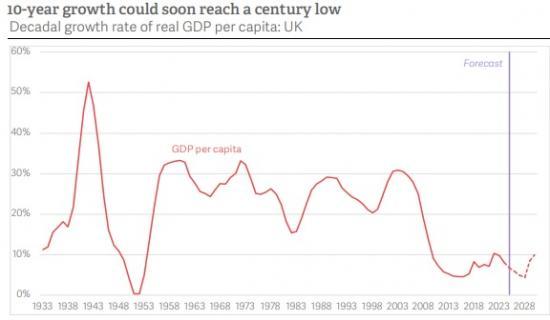
The Resolution Foundation's "Growth, Mais day" report makes one thing clear: the UK's economic challenge is no longer just about short-term shocks or policy cycles—it is about a deeper, structural slowdown that is reshaping how people live and work across the country. While "low growth" can sound abstract, its consequences are very real. It affects how much people earn, where opportunities are located, and whether entire regions can thrive or fall further behind.
At its core, weak growth means that the economy is not producing significantly more value year after year. And when that happens, the effects ripple outward—to wages, to job quality, and to geographic inequality.
Wages: Why Pay Feels Stuck
One of the most immediate consequences of weak growth is stagnant wages. Over the long run, pay rises when productivity rises—when workers produce more value per hour. But the UK has struggled with productivity for over a decade, and the report reinforces that this trend is continuing into the 2020s.
For workers, this translates into pay packets that barely keep up with inflation, let alone improve living standards. Even when nominal wages rise, real wage growth (after inflation) has been weak. This creates a sense of economic stagnation: people are working, but not getting meaningfully better off.
There is also a distributional angle. In a low-growth economy, it becomes harder for governments and businesses to deliver pay increases broadly. Gains are more likely to be concentrated in high-skill, high-productivity sectors—particularly those linked to technology and finance—while lower-paid workers see little improvement. This widens inequality not just between individuals, but across industries.
Jobs: Stability Without Progress
Low growth doesn't always mean mass unemployment. In fact, the UK labour market has often appeared resilient in headline terms. But the report suggests a more subtle problem: a labour market that may be stable, yet lacks dynamism and upward mobility.
In a stronger economy, workers can move into better jobs, firms expand, and new industries create fresh opportunities. In a weak-growth environment, those pathways narrow. Workers are more likely to remain in lower-productivity roles, and businesses are less inclined to invest in training or expansion.
The report's emphasis on innovation—particularly artificial intelligence—adds another layer of complexity. While new technologies could boost productivity, they may also reshape the labour market unevenly. High-skill workers may benefit from new opportunities, while others could face disruption or displacement. Without careful policy, this risks reinforcing existing divides.
Regions: A Deepening Divide
Perhaps the most striking implication of the report is what weak growth means for different parts of the UK. The country already has some of the largest regional disparities among advanced economies, and low growth threatens to entrench them further.
London and parts of the South East continue to outperform, driven by concentrations of high-value industries, skilled labour, and investment. These areas are better positioned to benefit from innovation and global economic links. In contrast, many towns and cities in the North, Midlands, and parts of Wales face lower productivity, weaker investment, and fewer high-paying job opportunities.
In a high-growth economy, lagging regions can catch up as investment spreads and opportunities expand. But in a low-growth environment, the opposite often happens: stronger regions pull further ahead, while weaker ones struggle to gain momentum. The economic "pie" is not growing fast enough to support meaningful convergence.
This is why the report places so much emphasis on regional policy. Addressing disparities is not just about fairness—it is essential for national growth. Underperforming regions represent untapped potential, but unlocking it requires sustained investment, improved infrastructure, and more local control over economic decisions.
Investment and Innovation: The Missing Link
A key theme running through the report is that the UK does not lack ideas or innovation. It has world-class universities, a strong research base, and leading firms in cutting-edge sectors. The problem lies in translating that innovation into broad-based economic gains.
Too often, productivity improvements are concentrated in a small number of firms or regions. The wider economy—especially smaller businesses and less prosperous areas—fails to adopt new technologies or practices at the same pace. This "diffusion problem" is a major reason why growth remains weak.
For workers, this matters because it shapes where good jobs are created. If innovation remains concentrated, so do the benefits: higher wages, better career prospects, and more resilient local economies. If it spreads, the gains can be shared more widely.
What This Means for the Future
Taken together, the report paints a picture of an economy where the main challenge is not crisis, but inertia. Growth is too weak to drive rising living standards, too uneven to reduce regional divides, and too narrowly distributed to benefit the majority of workers.
For individuals, this means a future where progress feels slower and less certain. For policymakers, it highlights the scale of the task ahead. Boosting growth is not just about headline GDP figures—it is about creating an economy where productivity gains translate into higher wages, better jobs, and more balanced regional development.
The government’s focus on growth, regional policy, and innovation is therefore well placed. But the report makes clear that success will depend on execution. Without sustained effort to increase investment, spread innovation, and empower regions, the UK risks remaining stuck in a low-growth equilibrium—one where opportunity is limited, uneven, and increasingly hard to expand.
In that sense, the UK’s growth problem is not just an economic issue. It is a question about the kind of country it wants to be: one where prosperity is broadly shared, or one where it remains concentrated in a few sectors and places.
Read the full Resolution Foundation report HERE