The Coming Oil Shock: How a Middle East War Could Tip the UK Into Recession
21st March 2026
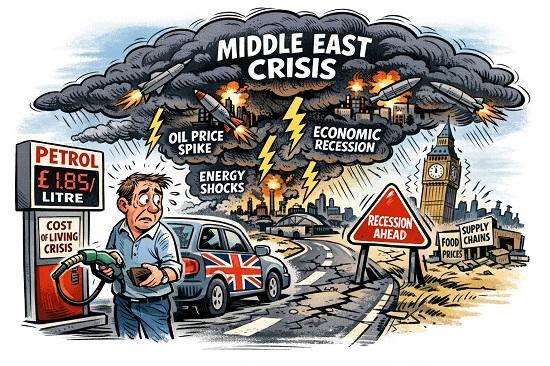
Oil shocks don't just make filling up the car more expensive. They drain spending power from households, push up business costs, and expose the structural weaknesses of economies that rely on imported energy.
With the conflict in the Gulf escalating into direct attacks on energy infrastructure, the UK now faces a level of economic risk we haven't seen since the 1970s.
A recession isn't inevitable. But the odds have risen sharply and Britain is entering this storm from a position of unusual fragility.
A Weak UK Economy Meets a Global Energy Shock
Long before the first missile struck a gas field, the UK was already struggling with -
inflation that never fully retreated after the 2021-23 energy crisis
stagnant productivity and weak business investment
a cost‑of‑living squeeze that left households with little financial buffer
interest rates stuck at levels that hurt mortgage holders and small firms
The Bank of England has been trapped between two bad choices - keep rates high to tame inflation, or cut them to revive growth. Either option carries risks. That’s the essence of stagflation — and Britain has been flirting with it for two years.
Now add a global oil shock to the mix
Fuel Prices Are Rising Fast and the UK Is Exposed
Brent crude’s surge above $119 a barrel sent immediate tremors through European fuel markets. UK petrol and diesel prices have already begun climbing, and rural areas from Cornwall to Caithness are feeling the pressure first.
Britain is structurally vulnerable in ways we rarely acknowledge
We import most of our oil and gas.
Our refining capacity has shrunk dramatically over the past two decades.
Our electricity system depends heavily on LNG imports.
We have some of the longest supply chains in Europe for fuel distribution.
When global prices jump, the UK feels it almost instantly.
Why High Fuel Prices Threaten Growth
Fuel demand is "inelastic": people and businesses can’t easily cut back when prices rise.
Households still need to drive to work, school, and care responsibilities.
Farmers still need diesel for tractors.
Hauliers still need to move goods.
Tradespeople still need vans.
Every extra pound spent at the pump is a pound not spent elsewhere. If UK households spend even £20 million more per day on fuel - a conservative estimate that’s £20 million drained from shops, cafes, services, and local economies.
This is how oil shocks trigger recessions: not through the price of oil itself, but through the forced reallocation of spending.
The War Has Shifted From Disruption to Destruction
The most alarming development is the shift from blocking shipping lanes to destroying energy infrastructure.
Recent strikes have hit:
the world’s largest LNG facility in Qatar
Iran’s South Pars gas field
refineries and petrochemical plants across the Gulf
storage depots and processing hubs in the UAE, Saudi Arabia, and Israel
Temporary blockages can be cleared.
Destroyed infrastructure takes years to rebuild
For the UK, this means:
higher LNG import costs
tighter diesel markets
more volatile electricity prices
renewed pressure on food prices due to fertiliser shortages
supply‑chain risks for pharmaceuticals
This is not a short‑term spike. It’s a structural shock.
Policy Options Are Painfully Limited
The UK government has very few levers left:
The Bank of England can’t cut rates without risking another inflation surge.
The Treasury can’t borrow freely without unsettling gilt markets.
Fuel duty cuts would blow a hole in public finances.
Energy subsidies risk reigniting inflation.
Emergency measures
Releasing reserves, tweaking regulations can soften the blow but cannot offset a global supply shock.
We are, in effect, passengers in a vehicle whose steering wheel has limited movement.
The Worst‑Case Scenario
A UK recession triggered by:
sustained high fuel and energy prices
falling consumer spending
rising business costs
renewed food inflation
supply‑chain disruptions in fertilisers and pharmaceuticals
a fragile global economy unable to absorb further shocks
This would hit low‑income households hardest and widen the gap between resilient urban centres and fragile rural regions.
Rural Britain Will Feel It First and Worst
In places like Caithness, the Western Isles, Cumbria, and rural Wales, the impact would be magnified.
These areas already face:
higher fuel prices due to long supply chains
limited public transport
dependence on cars for work, healthcare, and daily life
fragile local economies with thin margins
Every extra 10p on a litre of diesel hits farmers, tradespeople, carers, and commuters disproportionately hard. When fuel becomes unaffordable, rural economies don’t just slow — they seize.
A Moment for Honesty
The UK has spent decades drifting into energy dependence, under‑investing in resilience, and assuming global markets would always deliver cheap fuel. The Middle East conflict has exposed the fragility of that assumption.
We are not powerless but we are constrained. And unless the conflict de‑escalates quickly, Britain will face a difficult year ahead.
The question now is not whether the UK can avoid all pain. It’s whether we can manage it fairly, protect the most vulnerable, and use this crisis to confront the structural weaknesses we’ve ignored for too long.