Another Threat - The Bab el-Mandeb Strait Threat: What It Means for Global Oil Prices
29th March 2026
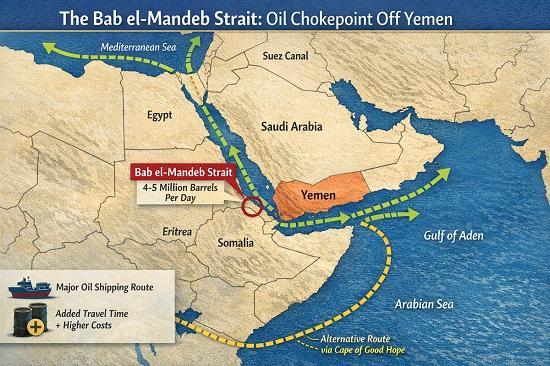
The narrow Bab el-Mandeb Strait, a crucial maritime chokepoint off the coast of Yemen, has recently become the focus of international attention as Houthi forces threaten to disrupt shipping through this vital passage.
Connecting the Red Sea to the Gulf of Aden, the strait serves as a critical artery for global trade, especially oil shipments from the Middle East to Europe, Asia, and North America. Any disruption here has the potential to send shockwaves through global energy markets.
Why Bab el-Mandeb Matters
Approximately 4 to 5 million barrels of oil pass through the Bab el-Mandeb Strait each day, representing around 5% of global oil shipments. Beyond crude oil, the strait also carries liquefied natural gas (LNG) and refined petroleum products. Its strategic significance is amplified by its role as a gateway to the Suez Canal, the fastest route connecting the Middle East to European markets. If the strait were blocked, vessels would need to take the longer and more costly route around the Cape of Good Hope, adding weeks to shipping times and substantially increasing transport costs.
Immediate Market Impact
Markets are extremely sensitive to supply disruptions, and any threat to the Bab el-Mandeb Strait is likely to trigger an immediate spike in oil prices. Historical precedents, such as tensions around the Strait of Hormuz, have shown that even the fear of disruption can push oil prices up by 5-10% in just days. A complete closure of the strait could see Brent crude surge above $120-130 per barrel, depending on the global supply cushion.
The oil price is increasing again and passed $112 dollars on Sunday 29 March 2026.
Insurance costs for tankers would also rise sharply, as shipping through conflict-prone areas is riskier. For countries relying heavily on Middle Eastern oil, this would translate to higher fuel costs for consumers and industries alike, creating broader economic pressures.
Broader Economic Consequences
Beyond oil markets, a blockage of the Bab el-Mandeb Strait could impact global trade and inflation. The strait is a conduit for many commodities, so disruptions could ripple through shipping logistics worldwide. Rising energy costs would add inflationary pressure, particularly in sectors heavily reliant on fuel and shipping.
Some mitigation is possible. Alternative routes, such as pipelines like SUMED in Egypt, can carry some volume, and strategic petroleum reserves in the US, Europe, and Asia could provide temporary relief. However, these measures are limited and would not fully offset the loss of the strait's capacity.
The Bab el-Mandeb Strait is more than just a narrow stretch of water off Yemen—it is a linchpin of the global energy supply chain. Even a temporary disruption could send oil prices soaring, strain shipping logistics, and exacerbate inflation worldwide. As tensions continue to simmer, the world watches closely, aware that geopolitical events in this small but strategically critical region can have outsized consequences for economies everywhere.