Critical Choke Points For Oil Transportation
29th March 2026
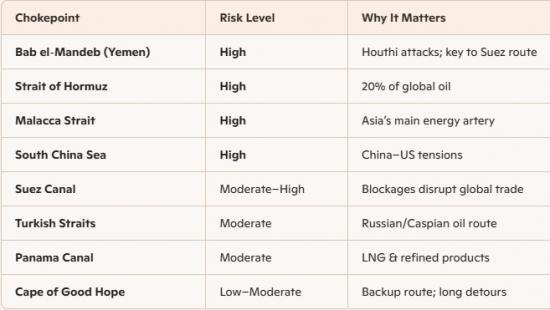
The Bab el-Mandeb Strait is one chokepoint, but there are several other critical locations globally where oil shipments are vulnerable to conflict, piracy, or political instability.
Details of the main choke points for oil.
1. Strait of Hormuz (between Oman and Iran)
Importance: Carries roughly 20% of the world's crude oil, one of the world's busiest oil chokepoints.
Threats: Tensions between Iran and Western countries have historically caused threats of closure or attacks on tankers. Even a temporary disruption here spikes global oil prices dramatically.
2. Suez Canal (Egypt)
Importance: Connects the Red Sea to the Mediterranean; critical for oil shipments from the Middle East to Europe and the Americas.
Threats: Political instability or maritime accidents (like the Ever Given blockage in 2021) can halt traffic. While not as conflict-prone as Bab el-Mandeb or Hormuz, a blockage can delay millions of barrels and disrupt global trade.
3. Malacca Strait (between Malaysia and Indonesia)
Importance: Main route for oil from the Middle East and Africa to East Asia, including China, Japan, and South Korea.
Threats: Historically prone to piracy, navigational congestion, and regional tensions. A blockage would force ships to detour via the Sunda or Lombok Straits, adding significant travel time.
4. Danish Straits / Baltic Sea
Importance: Routes Russian and other northern European oil exports to global markets.
Threats: Political tensions with Russia can threaten shipping security. Ice in winter can also occasionally impact transport.
5. Panama Canal
Importance: Allows faster shipping between the Atlantic and Pacific, reducing transit time for oil and LNG shipments.
Threats: Mechanical issues, natural disasters, or geopolitical disruptions could force ships to navigate around South America.
6. Gulf of Guinea (off West Africa)
Importance: Nigeria is a major oil exporter; tankers travel through this area to reach global markets.
Threats: Piracy is a growing concern, with attacks on oil tankers leading to increased insurance costs and delays.
7. Other Regional Risks
Red Sea & Yemen Coastline: Beyond Bab el-Mandeb, mines or small-boat attacks can threaten shipping.
Eastern Mediterranean: Increasing oil exploration could draw regional disputes affecting tanker routes.
Global oil transportation is highly dependent on a handful of strategic chokepoints, most of which are narrow, geopolitically sensitive, or susceptible to accidents and piracy. A disruption in any of these areas can ripple across global markets, often causing immediate spikes in oil prices and wider economic impacts.