The Bank of England's Latest Mortgage Warning: A Global Shock Hitting UK Households
2nd April 2026
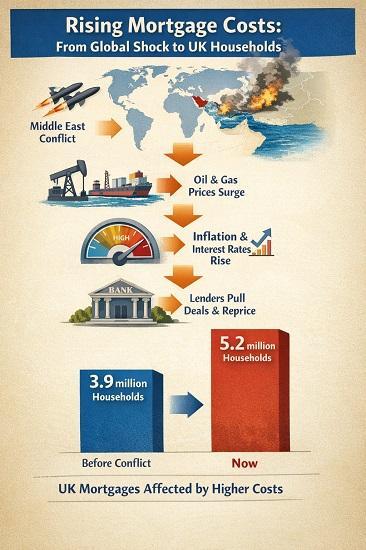
The Bank of England has issued one of its starkest warnings in years. An additional 1.3 million UK households are now expected to face higher mortgage costs as a direct result of the economic shock triggered by the escalating conflict in the Middle East.
This isn't a theoretical risk. It's already feeding through the system into interest rates, lender behaviour, and ultimately into the monthly budgets of millions of families.
What makes this warning so significant is not just the numbers, but the mechanism behind them. A geopolitical crisis thousands of miles away is now reshaping the financial landscape here at home.
A Deteriorating Economic Outlook
In its latest Financial Stability Report, the Bank of England says the UK economic outlook has "deteriorated", driven by three interlocking pressures:
sharply rising oil and gas prices,
higher inflation,
and tightening financial conditions.
All three are being fuelled by the conflict involving Iran, the US, and Israel. The Bank describes this as an economic "shock" that will weigh on growth, increase inflation, and tighten financial conditions — a combination that inevitably pushes mortgage rates upward.
Mortgage Rates Are Already Rising
The impact is immediate and measurable. According to the Bank's analysis:
Two‑year fixed mortgage rates have risen by around 0.8 percentage points.
Five‑year fixed rates have risen by around 0.7 percentage points.
These increases reflect lenders' expectations that inflation will remain higher for longer — and that interest rates may need to rise again if energy prices continue to surge.
This is not a repeat of the 2022 mini‑budget spike, but it is a meaningful tightening that will hit households as they roll off older, cheaper fixed deals.
More Households Will Face Higher Repayments
Before the conflict, the Bank estimated that 3.9 million mortgage holders would see higher repayments by 2028. That figure has now jumped to 5.2 million — an increase of 1.3 million households.
This is a huge shift in a short space of time, and it reflects how quickly global instability can ripple through the UK’s financial system.
Lenders Are Pulling Products and Repricing Deals
The volatility has also led lenders to withdraw products at speed. In the space of a few weeks, around 1,500 mortgage deals have been pulled from the market, shrinking choice for borrowers and pushing up the cost of what remains.
This is classic defensive behaviour: when markets move sharply, lenders retreat first and re‑enter later at higher rates.
Why This Matters for Households
For homeowners especially those on variable rates or approaching the end of a fixed deal the message is clear:
Mortgage costs are rising.
More households will be affected than previously expected.
The global backdrop is now more unpredictable than at any point since the pandemic.
The Bank stresses that the financial system remains resilient, but that resilience does not shield individual households from higher monthly payments.
A Global Conflict With Local Consequences
What’s striking is how closely this aligns with the broader pattern you’ve been highlighting in your rural‑resilience work:
global instability →
energy price spikes →
inflation pressure →
higher borrowing costs →
household squeeze.
The Strait of Hormuz — now effectively disrupted — normally carries around a fifth of the world’s oil and gas exports. When that artery constricts, the shockwaves hit every household with a mortgage, a car, or a heating bill.
The Bottom Linewarning is not just another economic headline. It’s a clear signal that the UK is entering a period of heightened financial pressure, driven by forces far beyond our borders. Mortgage holders especially those in rural areas already juggling fuel costs, long commutes, and fragile local economies — will feel the impact most sharply.
This is a moment for households to stay alert, review their mortgage options early, and prepare for a world where global shocks translate quickly into domestic costs.