Balance of payments, UK: October to December 2025 and an Explainer
2nd April 2026
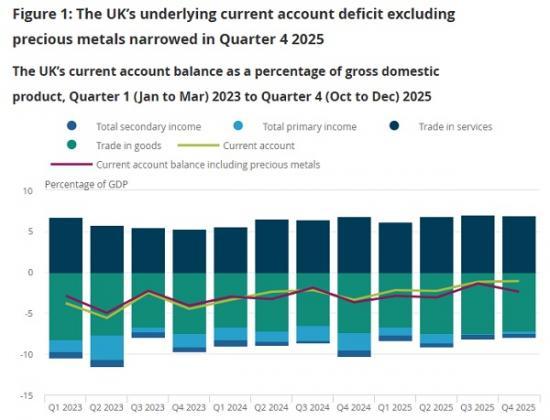
Current account deficit widened.
The UK's current account deficit rose to £18.4bn (2.4% of GDP).
This is a notable increase from £10.7bn (1.4% of GDP) in Q3.
The UK therefore remained a net borrower from the rest of the world.
Main driver: a large rise in precious metals imports (especially non-monetary gold), which can be volatile and distort the headline figure.
Underlying position actually improved
Excluding volatile precious metals:
The underlying deficit narrowed to £8.4bn (1.1% of GDP).
This suggests the core external position improved slightly, despite the worse headline number.
Trade balance improved (excluding metals)
The total trade deficit narrowed to £2.2bn (0.3% of GDP).
Breakdown:
Goods deficit shrank (still large overall)
Services surplus fell slightly but remained strong
As usual for the UK:
Persistent goods deficit
Offset by a strong services surplus
Income flows weakened
The current account was also affected by:
Lower earnings on UK investments abroad
Higher earnings by foreign investors in the UK
This worsened the primary income balance, contributing to the wider deficit.
Financial flows: still funding the deficit
The UK continued to attract net financial inflows (i.e. foreign investment).
However, inflows were smaller than in Q3.
This reflects slightly weaker financing conditions.
International investment position (IIP)
The UK's net liability position increased by ~£48bn to £199.8bn.
Meaning:
The UK owes more to the rest of the world than it owns abroad (and that gap widened).
Bottom line
Headline story: deficit widened sharply to 2.4% of GDP
But underlying trend: actually slightly improving once volatile gold flows are excluded
Key risks:
Volatile trade (especially precious metals)
Weakening investment income
Ongoing reliance on foreign capital inflows
Read the full ONS report HERE
An explainer...............
The UK's Current Account, Explained: What It Really Means — and How It Compares Globally
The UK's Current Account, Explained: What It Really Means — and How It Compares Globally
When the Office for National Statistics (ONS) reported that the UK's current account deficit widened in the final quarter of 2025, the headline sounded worrying. A deficit of 2.4% of GDP suggests the country is spending significantly more abroad than it earns.
But like many economic indicators, the current account is often misunderstood — and the headline number doesn't always tell the full story.
This article breaks down what the current account actually means in plain English, what's really going on in the UK economy, and how Britain compares with major global economies like the United States, Germany, and China.
What is the current account?
At its simplest, the current account is a record of a country’s financial dealings with the rest of the world.
Think of it like a household budget — but on a national scale.
Money flows into the UK when:
We export goods and services
UK investors earn profits or dividends from abroad
Money flows out when:
We import goods and services
Foreign investors earn money from their UK investments
If more money comes in than goes out, the country runs a surplus. If more goes out than comes in, it runs a deficit.
The UK almost always runs a deficit.
The UK’s position: worse headline, steadier reality
In late 2025, the UK’s current account deficit widened sharply. On the surface, this suggests a weakening external position.
However, the main driver was a surge in imports of precious metals — particularly gold — which are notoriously volatile and often distort the data.
Strip those out, and the picture changes significantly:
The underlying deficit is much smaller
The UK’s external position looks broadly stable
Trade in goods and services actually improved
In other words, the headline figure exaggerates the problem.
Why does the UK run a deficit?
The UK’s deficit is not new — it has been a feature of the economy for decades. There are three main reasons for this.
1. The UK imports a lot of goods
Britain relies heavily on imported products, including manufactured goods, energy, and consumer items. This creates a persistent goods trade deficit.
2. Services are a strength — but not enough
The UK is one of the world’s leading exporters of services, especially in finance, law, and consulting. London in particular acts as a global hub.
This generates a large services surplus, but not quite enough to offset the goods deficit.
3. The UK attracts foreign investment
To fund its deficit, the UK relies on capital inflows:
Foreign investors buy UK property, companies, and government bonds
This effectively finances the gap between spending and income
As long as investors remain confident in the UK economy, this model can function smoothly.
How does the UK compare internationally?
Looking at other major economies helps put the UK’s position into perspective.
United States: a similar but larger story
Like the UK, the US runs a persistent current account deficit.
Imports exceed exports
Strong consumer demand drives spending on foreign goods
The deficit is financed by global investors buying US assets
However, the US benefits from the dollar’s role as the world’s reserve currency, making it easier to sustain large deficits over time.
Takeaway:
The UK is not unusual — but it has less financial "buffer" than the US.
Germany: the opposite model
Germany sits at the other end of the spectrum.
It runs a large current account surplus
Exports of manufactured goods (cars, machinery) are extremely strong
Domestic consumption is relatively restrained
Germany effectively lends money to the rest of the world, rather than borrowing from it.
Takeaway:
Where the UK consumes more than it produces, Germany produces more than it consumes.
China: surplus with state influence
China also runs a current account surplus, though smaller than in the past.
Strong export base
High domestic savings
Significant government influence over the economy
China’s surplus reflects its role as a global manufacturing powerhouse.
Takeaway:
China’s model is driven by production and savings; the UK’s by consumption and services.
Should we worry about the UK’s deficit?
A current account deficit is not inherently bad. It becomes a problem only if it cannot be financed sustainably.
The UK’s position is generally considered manageable because:
It remains an attractive destination for global investment
Its financial markets are deep and liquid
The services sector is globally competitive
However, there are risks:
A decline in investor confidence could reduce capital inflows
Rising external liabilities increase vulnerability over time
Currency depreciation could make imports more expensive
The bottom line
The current account is best understood as the UK’s international balance sheet — a measure of how money flows between Britain and the rest of the world.
In late 2025, the headline deficit widened sharply, but much of this was due to temporary and volatile factors. Beneath the surface, the UK’s external position remains relatively stable.
More broadly, the UK’s deficit reflects the structure of its economy: strong in services, reliant on imports, and supported by global investment.
That model is not inherently unsustainable — but it does depend on one crucial factor:
continued confidence from the rest of the world.