North Sea Oil and the Great British Fuel Illusion - Ask The Candidates For Election
4th April 2026
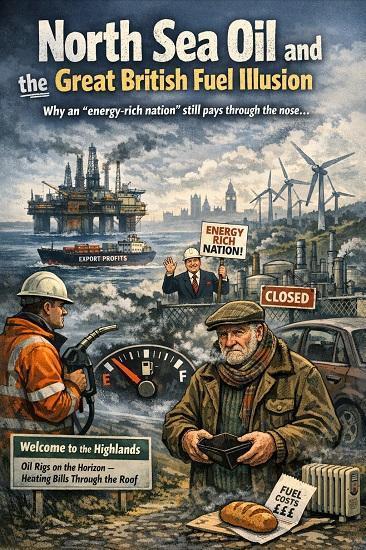
Why an "energy‑rich nation" still pays through the nose — and why the Highlands are done pretending it makes sense.
For half a century, politicians have stood on windswept platforms in hard hats, pointing at the North Sea and declaring Britain an “energy‑rich nation”. It's a lovely line so stirring, patriotic, and about as connected to reality as a weather forecast written by a poet. Because every time global markets twitch, the UK doesn’t just wobble; it keels over like a pensioner on black ice. Some “energy superpower”.
The truth is painfully simple. The North Sea is a resource we export, not a shield we benefit from. Oil companies sell to the highest bidder, not to the British public. Most of our refining capacity has been shut down or sold off. And domestic production doesn’t magically mean domestic protection unless you believe that owning a cow guarantees free milk. In practice, it’s more like owning a cow, selling all the milk abroad, and then buying your breakfast from Tesco at full price.
What really grates in the Highlands is that the communities who lived with the industry — the noise, the traffic, the disruption, the promises — are now the same communities paying the highest fuel prices in the country. People in Caithness look out at rigs, pipelines, tankers, substations, and now forests of turbines, and ask the most reasonable question imaginable, “How can we be surrounded by energy and still be freezing, skint, and driving on fumes?” It’s the kind of question that makes candidates shuffle their papers and start talking about “long‑term strategies”, which is political code for “I don’t have an answer, but I hope you’ll forget you asked”.
Every election brings the same slogans about “energy independence” and “security of supply”, as if repeating the words will somehow conjure up storage facilities, functioning refineries, or a pricing system that doesn’t treat rural households like an afterthought.
Commentators have pointed out for years that successive governments allowed the UK’s energy resilience to wither. Storage was neglected. Infrastructure was sold off. Imports became the default. And then, when global prices spiked, everyone acted shocked like a landlord who’s surprised the roof leaks after ignoring it for twenty years.
Meanwhile, the far north sees the contradiction more clearly than anyone. We host the infrastructure. We live with the consequences. We pay the highest prices. And we get the least say. It’s a familiar pattern. Value flows south and costs stay north. The only thing that travels north reliably is the political photo‑op usually involving a hi‑vis vest, a forced smile, and a promise that “this time, things will be different”. Aye, right.
So as the Scottish elections approach, voters in the Highlands are perfectly entitled to ask a very simple, very awkward question, "If the North Sea couldn’t protect us from the fuel crisis, what exactly is your plan now?" Not a slogan. Not a glossy leaflet. A plan. Because the patience of the far north is wearing thin, and the old lines about “energy riches” don’t mean much now. You can only sell the same illusion for so long before people start noticing the draught coming through the cracks. Ask the candidates in the upcoming election if you get the chance.