From Manila to Caithness: What the Asian Fuel Meltdown Says About Britain's Rural Blind Spot
4th April 2026
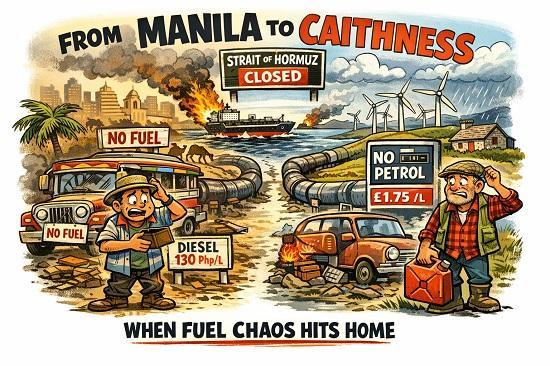
When the world's energy arteries clog, it's always the periphery that feels the chest pain first
If you want to see the future of rural Britain during a global energy shock, don't look to Westminster look to Manila. The Philippines is currently living through the kind of fuel crisis that turns daily life into a logistical puzzle: jeepneys parked up, commuters stranded, diesel prices doubling, and the government declaring a national energy emergency with all the enthusiasm of someone announcing a fire drill in a burning building.
Indonesia, Thailand, Vietnam they’re all scrambling too. Offices are shifting to four‑day weeks, governments are begging people to stay home, and Myanmar has introduced alternating driving days, which is basically the state saying, "We can’t fix this, but we can make it slightly more inconvenient." It’s chaos, but it’s predictable chaos because these countries rely heavily on Gulf‑state oil, and when the Strait of Hormuz shuts down, their economies wobble like a three‑legged table.
And here’s the uncomfortable bit. The Highlands has far more in common with these countries than London would ever admit.
We like to imagine we’re insulated because we’re part of a wealthy, "energy‑rich" nation. But the moment global oil prices spike, Caithness feels it faster than the M25 feels a raindrop. Heating oil jumps. Petrol stations quietly add 5p, then 10p, then pretend it’s always been that way. Households with no buses, no trains, and no alternatives simply have to swallow the cost.
It’s the same pattern you see in Southeast Asia: long supply chains, no local control, and a political centre that assumes everyone lives within walking distance of a Tesco.
The Philippines has jeepneys and we have battered hatchbacks doing 40‑mile round trips for a loaf of bread. Indonesia worries about LNG shipments. We worry about tankers turning back from the North Sea because someone in Rotterdam is paying a penny more per litre. Thailand urges civil servants to work from home. Highland council quietly cut services because the fuel budget has evaporated faster than a puddle in July.
Different continents, same vulnerability.
What really ties the Highlands to Southeast Asia is the irony that regions closest to energy infrastructure often benefit the least. Filipinos live beside LNG terminals yet face blackouts.
Highland communities live under forests of turbines yet pay some of the highest electricity prices in Europe. The Philippines exports workers to Gulf oil states; the Highlands exports renewable power south. In both cases, value flows outward while vulnerability stays local like a bad joke told by someone who doesn’t realise you’re the punchline.
And just like Manila, we’re at the mercy of decisions made far away. The Philippines doesn’t control the Strait of Hormuz. The Highlands doesn’t control the UK’s refining capacity, pricing system, or distribution networks. When global markets twitch, we don’t get a say. We just get the bill.
The lesson from Southeast Asia is brutally simple. Energy resilience isn’t a luxury it’s survival. And rural areas, whether in Luzon or Caithness, are always the first to feel the shockwaves when the world’s energy arteries clog. The Philippines’ crisis isn’t some distant drama it’s a preview of what happens when a region depends on long supply chains, imported fuel, and distant decision‑makers who think "rural" means “Surrey with sheep.”
If the Highlands wants to avoid Manila‑style chaos the next time the world sneezes, it needs more than slogans about “energy security.” It needs actual control over the energy it produces, stores, and consumes. Because right now, we’re far closer to Manila than Westminster would ever dare admit.
And the next global shock won’t wait for us to catch up.