Why Self?Driving Cars Will Have to Adapt to Runners And Not the Other Way Around
5th April 2026
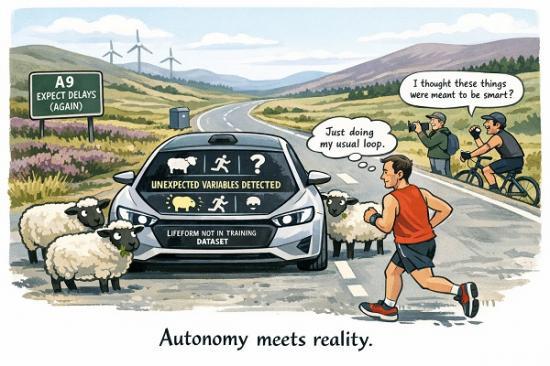
The debate around self‑driving cars has always carried a faint whiff of technological inevitability. The idea that the machines will arrive, the roads will change, and the rest of us will simply fall into line.
But a growing body of research is quietly puncturing that narrative. It turns out that autonomous vehicles may not be the all‑seeing, all‑knowing chauffeurs Silicon Valley promised. In fact, they may struggle with one of the most common, unpredictable, and stubbornly human behaviours on the road: running.
Runners are not pedestrians in the traditional sense. They move faster, take more risks, and make decisions based on rhythm, momentum, and bodily instinct rather than careful observation. A walker pauses at a kerb. A runner often doesn't. A walker looks both ways. A runner glances, calculates, and commits. And in simulation studies, runners were "struck" by virtual autonomous vehicles far more often than walkers not because they were reckless, but because the vehicles simply weren't trained to anticipate their behaviour.
This is the heart of the problem. Autonomous systems are built on patterns: millions of hours of footage, billions of data points, all feeding into a model that predicts what a human should do next. But runners don’t behave like the average human. They behave like runners. They surge, they dart, they accelerate unexpectedly. They treat the road as a temporary obstacle rather than a fixed boundary. And the machines, for all their computational power, struggle with that kind of spontaneity.
Researchers now argue that self‑driving cars will need new ways to communicate with fast‑moving road users. External light signals, clearer yielding cues, and even wearable alerts for runners are being explored. The goal is to replace the subtle, non‑verbal negotiation that human drivers perform instinctively such as the eye contact, the nod, the slight lift of the hand with something a machine can deliver consistently.
But the deeper implication is harder for the tech world to swallow: the future of autonomous transport may depend less on humans adapting to machines, and more on machines adapting to the messy, unpredictable reality of human movement. Runners are not going to slow down to accommodate a robot car. Nor should they. Roads are shared spaces, and if autonomous vehicles are to earn their place on them, they must learn to read the full spectrum of human behaviour not just the tidy, cautious version that exists in training data.
In the end, the runner becomes a symbol of something larger. They represent the part of human life that refuses to be tidied up for technological convenience. And if the machines want to join us on the road, they’ll have to learn to keep up.