Empty Desks, Full Bills - The quiet cost of Scotland's half?used government offices
5th April 2026
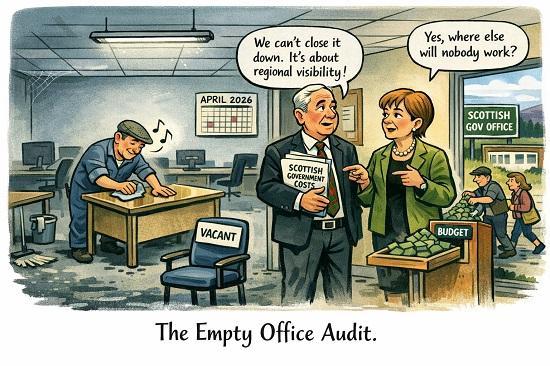
Walk past a Scottish Government building these days and you might wonder if anyone's home. The lights are on, the heating hums, and the cleaners still make their rounds but the desks are empty. Hybrid working has hollowed out the public estate, leaving taxpayers footing the bill for space that's barely used.
According to recent parliamentary papers and press investigations, millions are being spent each year maintaining offices that now host a handful of staff. Some regional sites, once symbols of decentralisation, have become expensive monuments to bureaucracy. They are heated, secured, and serviced for fewer than twenty people. The irony is painful as the government preaches efficiency while paying for buildings that echo with absence.
Ministers defend the arrangement as a commitment to regional presence, arguing that closing offices would send the wrong message to communities outside Edinburgh. But symbolism doesn't pay the bills. The cost of administration has nearly doubled since 2018, driven by estate maintenance and IT systems that no longer match the workforce. Every pound spent keeping an empty office warm is a pound not spent on frontline services.
The pandemic forced a rethink of how Scotland works but not, it seems, of where it works. Hybrid patterns were meant to save money and cut carbon Instead, they’ve left a trail of half‑used buildings and full‑priced leases. The result is a public sector caught between nostalgia and necessity, unwilling to admit that the old model no longer fits.
If the government truly believes in efficiency, it must treat its estate like any other asset: review, repurpose, or release. Otherwise, the taxpayer will keep paying for the illusion of presence. A network of offices that exist more on paper than in practice.