When Curriculum for Excellence Lost Its Way and Why Rural Scotland Felt It First
5th April 2026
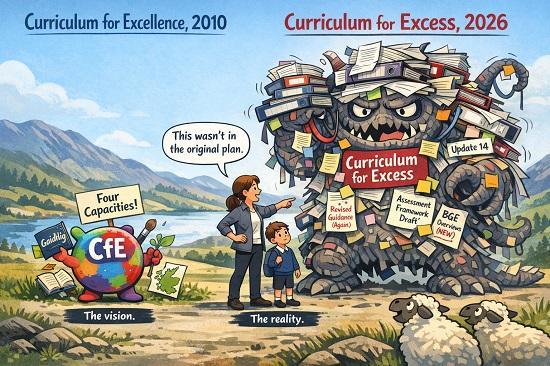
Curriculum for Excellence began with a promise. A modern, flexible, child‑centred approach that would free Scottish education from rigid structures and allow teachers to shape learning around their communities.
In the Highlands, that promise resonated deeply. Rural schools have always needed adaptability composite classes, small rolls, multi‑stage teaching, and a curriculum that reflects local life rather than a centralised template.
But somewhere between the vision and the implementation, CfE drifted. What was meant to be a streamlined, empowering framework gradually thickened into a dense forest of guidance, benchmarks, and bureaucratic expectations. And as that drift accelerated, rural schools — already stretched thin felt the consequences more sharply than anyone in St Andrew's House seemed willing to acknowledge.
The Highlands needed simplicity. CfE delivered complexity
The original CfE was built on trust: trust in teachers' judgement, trust in local context, trust in professional autonomy. But over time, the system layered on:
detailed benchmarks
national moderation requirements
assessment frameworks
refreshed guidance
senior‑phase alignment documents
endless "updates" and "clarifications"
For a large urban school with departments and specialist staff, this was burdensome but survivable.
For a two‑teacher school in Caithness or Sutherland, it was suffocating.
The curriculum that was meant to liberate teachers instead buried them under paperwork.
The senior phase drift widened the rural disadvantage
The OECD has already said the senior phase no longer matches CfE's philosophy.
In the Highlands, that mismatch becomes structural:
limited subject choice
reliance on distance learning
timetable clashes
long travel times
fewer Advanced Highers
smaller staff teams
When CfE drifted, the senior phase drifted further and rural pupils were left navigating a system that promised breadth but delivered constraint.
The Broad General Education shrank under pressure
The BGE was supposed to be rich, interdisciplinary, and locally shaped.
But as attainment pressures grew, schools were nudged back toward measurable, exam‑aligned content.
In rural areas — where outdoor learning, crofting heritage, land‑based skills, and community‑embedded projects should thrive — the system quietly pulled teachers back indoors and back to the testable.
The irony is painful: CfE’s most distinctive strengths were the first casualties of its drift.
Workload in rural schools isn’t just higher — it’s different
A rural teacher is not just a subject specialist.
They are:
guidance
learning support
librarian
community liaison
extracurricular organiser
sometimes bus duty, sometimes first aider
When CfE became overloaded, rural teachers didn’t have a department to share the burden with.
They carried it alone.
The drift widened the rural attainment gap
Not because rural pupils are less capable — far from it.
But because a curriculum that demands constant documentation, moderation, and alignment punishes small schools with limited staff.
The system’s complexity became a barrier to equity.
What the Highlands need now
Not another glossy refresh.
Not another round of "updated guidance."
But a curriculum that:
restores simplicity
aligns the senior phase with the BGE
trusts rural teachers
values local context as a strength
reduces bureaucratic clutter
recognises the reality of small‑school timetables
supports genuine breadth, not theoretical breadth
CfE didn’t fail because its philosophy was wrong.
It faltered because the system forgot that clarity is not the enemy of ambition, and that rural schools need flexibility, not frameworks that grow like bindweed.
The Highlands were supposed to be the place where CfE shone brightest.
Instead, they became the place where its drift was felt first and hardest.