The UK's Fuel Warning: What's Really Being Said - And What It Means for Caithness and the Highlands
14th April 2026
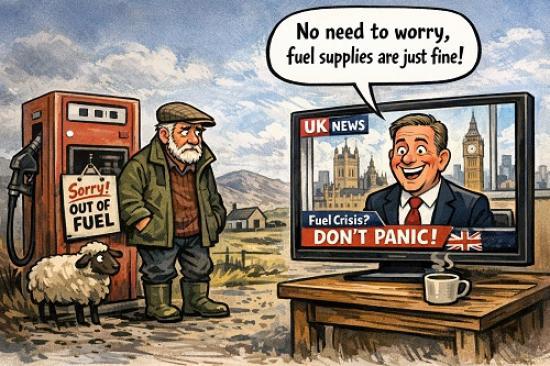
The past week has seen a surge of headlines claiming the UK "could run out of fuel by the end of the month."
Beneath the noise, a more serious and credible warning has emerged from energy‑security experts particularly Nick Butler, former BP head of strategy and Downing Street energy adviser who argues that the UK should already be preparing a fuel contingency plan.
His concern is not sensationalism but a sober assessment of the UK's exposure to global supply shocks, especially with the Strait of Hormuz disrupted by the escalating Iran-Middle East conflict.
The Expert Warning Behind the Headlines
Nick Butler's assessment
Butler's intervention is the most significant because he has both industry and government experience. His key points:
The UK should be preparing for fuel rationing if the Gulf crisis persists.
There is a risk of a "real physical shortage of supply in a few weeks' time."
Essential sectors such as NHS, food distribution, emergency services should be prioritised.
The UK is more vulnerable than it admits because it imports a large share of refined fuels, not just crude oil.
He does not say the UK will literally "run out by the end of the month," but he does warn that the risk window is weeks, not months.
Industry voices adding pressure
Michael O'Leary, Ryanair CEO, has warned of 10-25% jet‑fuel supply disruption across Europe and the UK if the conflict worsens.
Aviation analysts say airlines may need to cut routes or raise fares sharply.
Logistics firms are quietly modelling diesel shortages and delivery delays.
These are not predictions of collapse but they are signals of strain.
Media amplification
Some newspapers, especially the Daily Express, have taken these warnings and produced dramatic headlines:
"UK could run out of fuel by the end of the month"
"Government dusts off rationing plan"
“Emergency fuel map shows UK at risk”
These headlines exaggerate the timeline, but they reflect genuine concern within parts of the energy sector.
Government position
The UK Government insists:
There is no current shortage.
The UK has diverse supplies.
Emergency plans are reviewed routinely.
All technically true but it avoids the central issue: the UK has no strategic fuel reserve, unlike the US, France, Germany, or Japan.
Why Caithness and the Highlands Are More Exposed Than Most of the UK
Long, fragile supply chains
Fuel for Caithness travels hundreds of miles from the Central Belt or import terminals. Any disruption — refinery issues, tanker shortages, blocked roads, or rationing — hits the far north first and longest.
Limited competition and redundancy
There are fewer fuel stations, fewer distributors, and almost no alternative supply routes. If one supplier has a problem, there is no fall back.
High dependency on private transport
With limited public transport, rural households rely on:
Cars for work
Cars for medical appointments
Cars for shopping
Oil heating in many homes
A fuel shock hits rural households twice: at the pump and in the heating bill.
Seasonal pressures
Spring and early summer bring:
Tourism
Agricultural machinery demand
Increased freight movement
A supply shock now would be badly timed for the Highlands.
Past experience of being “last in the queue”
Caithness has lived through:
Heating‑oil delays
Petrol station outages
Price spikes that hit rural areas harder
The region knows how quickly a national issue becomes a local crisis.
What People Can Realistically Do Without Panic Buying
This is not about hoarding. It is about rural resilience.
Sensible steps for households
Keep car tanks above half rather than running them low.
Order heating oil earlier than usual.
Combine errands to reduce unnecessary trips.
Use local shops when practical to reduce long‑distance travel.
For farms, crofts, and rural businesses
Service generators and ensure they are ready.
Keep a modest amount of diesel for essential machinery.
Review emergency plans for livestock, refrigeration, and critical equipment.
Stay informed locally
Local stations often post:
Delivery schedules
Temporary shortages
Price changes
This helps avoid wasted journeys.
Political pressure
The Highlands have a strong case for:
A regional fuel resilience plan
Priority deliveries for remote communities
A Scottish‑level strategic reserve
Better transparency on supply risks
Urban‑centric assumptions often ignore rural fragility — and Caithness has been correcting those assumptions for decades.
What a Realistic Worst‑Case Scenario Looks Like
Not “running out by the end of the month,” but:
Short‑term local shortages
10-20% price spikes
Reduced deliveries to remote areas
Heating‑oil delays
Priority allocation for essential services
Aviation disruption affecting Inverness and Wick-John O’Groats
For Caithness, the biggest risk is intermittent supply gaps, not total collapse.
What a Realistic Best‑Case Scenario Looks Like
The Strait of Hormuz reopens.
Oil prices stabilise.
The UK quietly updates its emergency plans.
No rationing, no shortages — just higher prices for a while.
This outcome is entirely possible.
A Bit Of Realism
The UK is not about to run out of fuel tomorrow but credible experts are warning that the country is unprepared for a serious supply shock. For Caithness and the Highlands, where supply chains are long and fragile, the risks are sharper than for the Central Belt or the south of England.
The sensible response is not panic, but preparedness: keeping tanks topped up, reducing unnecessary travel, ensuring rural businesses have backup plans, and demanding that policymakers finally take rural fuel resilience seriously.