Thirty Achievements and Failures: A Balanced View of the Scottish Government (2021-2026)
17th April 2026
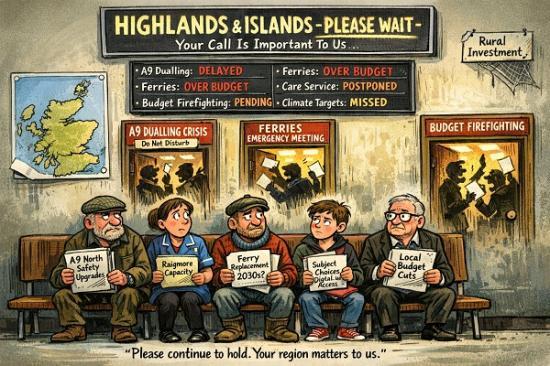
The last parliamentary term of the Scottish Government was marked by a mix of notable achievements and significant challenges. This article combines thirty key successes with thirty notable failures to provide a comprehensive perspective on the government's performance, especially in relation to the Highlands and rural communities.
Thirty Achievements
1-6: Social Justice and Family Support
Scottish Child Payment — Raised to £27 per week per child, credited with lifting thousands out of poverty.
Baby Box scheme — Universal provision for newborns, now emulated internationally.
Free personal and nursing care — Extended to all ages.
Expansion of funded childcare — 1,140 hours of free early learning per child.
Social Security Scotland — Built from scratch, delivering 15 devolved benefits.
Free prescriptions — Saving households hundreds annually.
7-12: Health and Care Investment
Record NHS funding — Over £19.5 billion, doubling frontline spend since devolution.
Record NHS staffing — 33,000 more doctors, nurses and allied professionals.
Mental health strategy expansion — New community hubs and youth services.
Free dental care for under‑26s — Reducing cost barriers for young adults.
Improved cancer screening uptake — Targeted outreach in rural areas.
Digital health pilots — Remote consultations extended to island communities.
13-18: Housing and Local Development
133,000 affordable homes delivered — With a new target of 110,000 more by 2032.
Energy‑efficient retrofit grants — Supporting rural insulation and heating upgrades.
Community Empowerment Act reforms — Strengthened local ownership rights.
Island Housing Fund — Dedicated support for small‑scale builds in Orkney, Shetland and the Western Isles.
Town Centre Action Plan — Funding for regeneration in Wick, Thurso and similar towns.
Land reform progress — New powers for community buyouts and transparency in ownership.
19-24: Education and Skills
Free university tuition maintained — Protecting access based on ability, not income.
Record apprenticeships — Over 25,000 new starts annually.
STEM outreach in rural schools — Expanding digital and science education.
Gaelic medium education growth — New units in Highland and Western Isles.
College investment in green skills — Aligning training with renewables and hydrogen.
Teacher bursaries for remote areas — Incentives to fill rural vacancies.
25–30: Environment, Economy and Governance
Natural Environment Act — Legally binding nature‑recovery targets.
Circular Economy Act — Framework for waste reduction and reuse.
Nature Restoration Fund — £65 million invested in peatland and biodiversity.
Marine protection measures — New offshore management zones.
Record renewable generation — Over 97 % of electricity from renewables in 2025.
Fiscal Sustainability Plan — Multi‑year budgeting and efficiency reforms to stabilise public finances.
Thirty Failures
1–6: Infrastructure and Transport
Ferry service disruptions — Ongoing delays and cancellations affecting island connectivity.
Road maintenance backlog — Deteriorating rural roads with insufficient funding.
Rail service unreliability — Frequent delays and cancellations impacting remote communities.
Lack of investment in active travel — Insufficient cycling and walking infrastructure.
Airport funding cuts — Reduced support for regional airports.
Delayed broadband rollout — Rural areas still facing poor internet access.
7–12: Economic and Employment Challenges
Slow business support response — Delays in grants and aid during economic downturns.
Persistent rural unemployment — Higher joblessness in remote areas.
Limited support for traditional industries — Fishing and agriculture facing regulatory and financial pressures.
Inadequate tourism promotion — Missed opportunities for Highlands and islands.
Skills mismatch — Training not fully aligned with local economic needs.
Insufficient support for small businesses — Complex regulations and limited access to finance.
13–18: Health and Social Care Issues
Hospital waiting times — Lengthy delays for elective procedures.
Care home staffing shortages — Impacting quality of care.
Mental health service gaps — Unequal access in rural areas.
Delayed implementation of health IT systems — Hindering efficiency.
Inconsistent social care funding — Variability across regions.
Limited support for carers — Insufficient respite and financial aid.
19–24: Education and Youth Services
School closures in rural areas — Reducing local access to education.
Teacher recruitment challenges — Difficulty filling remote posts.
Digital divide in education — Unequal access to technology.
Cuts to youth services — Impacting community engagement.
Limited vocational training options — Affecting employability.
Inadequate mental health support in schools — Rising concerns.
25–30: Governance and Policy Implementation
Centralisation of decision-making — Reduced local autonomy.
Delays in infrastructure projects — Cost overruns and missed deadlines.
Transparency issues — Lack of clear communication on spending.
Ineffective regional development strategies — Limited impact on rural regeneration.
Environmental policy enforcement gaps — Challenges in implementation.
Fiscal pressures limiting service delivery — Budget constraints affecting outcomes.
For Caithness, Sutherland and the islands, this combined view highlights the dual reality of progress and ongoing challenges. While social payments, housing, and environmental laws have brought benefits, infrastructure and service delivery gaps remain pressing concerns.
The Scottish Government's 2021–2026 term was a study in contrasts. Achievements in welfare, health, education, and environment demonstrate what is possible when policy aligns with local needs. Yet, failures in infrastructure, economic support, and governance reveal areas demanding urgent attention. The next parliament faces the critical task of bridging these divides to ensure balanced, inclusive progress across all regions.
There are many other issues not included in the above list such as the bottle return scheme. More locally Caithness still awaits the health hubs promised 10 years ago but nowhere near starting to build.
Councils and Health Boards across Scotland have huge deficits in funding leading to gradual decline in services. No easy fixes are likley.
When government connects national ambition with local delivery, the Highlands and rural Scotland can truly thrive not as an afterthought, but as a central priority.
Governing a country is not easy and any new government will face the same issues and time will tell if thy are more or less successful