The Great Egg Panic: Or How We All Briefly Lost Our Minds Over Breakfast
17th April 2026
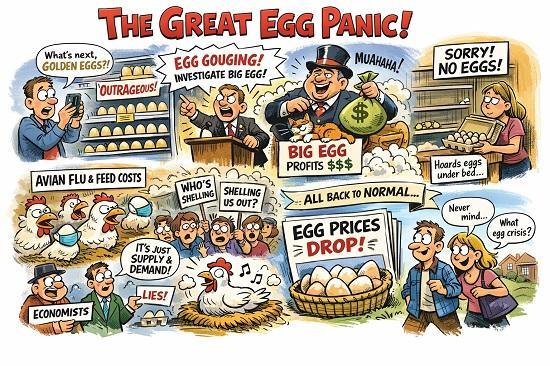
There was a moment—not long ago, though it now feels like a strange fever dream—when eggs became the most controversial objects in the United Kingdom and the United States. Not oil. Not housing. Not war.
Eggs
Perfect, oval, quietly nutritious eggs.
And then suddenly, they were everywhere in the news. Or rather, conspicuously absent from shelves, replaced by hand-written signs, raised eyebrows, and a growing suspicion that somewhere, somehow, someone was getting very rich off omelettes.
Phase One: The Discovery
It began, as these things often do, with a mildly annoyed shopper.
"Three pounds fifty? For eggs?"
This was followed by the universal modern reflex: photographing the price tag and uploading it with a caption that implied civilisation itself was in decline.
Within days, the narrative escalated.
Eggs were no longer expensive—they were suspiciously expensive.
And if something is suspiciously expensive, then naturally:
someone must be profiteering
preferably a large, vaguely named corporation
possibly while stroking a cat
Phase Two: The Outrage
Soon, politicians entered the chat.
In both the UK and the US, serious people stood behind serious podiums and said serious things about eggs. Committees were suggested. Investigations were floated. The phrase “price gouging” began to circulate with the quiet menace of a word that had been waiting patiently for its moment.
Meanwhile, the public reaction evolved:
Shoppers began hoarding eggs, just in case
Social media filled with egg-based conspiracy theories
Amateur economists emerged overnight
At one point, it seemed entirely plausible that eggs might require:
ration cards
security escorts
or their own central bank
Phase Three: The Villains
No crisis is complete without a villain.
Enter: The Egg Producers.
These shadowy figures—previously known only for calmly existing—were suddenly recast as master strategists, orchestrating a grand yolk-based conspiracy.
“How else,” people asked, “could eggs be so expensive?”
It did not seem to matter that:
millions of chickens had been culled due to disease
feed and energy costs had surged
rebuilding supply takes time
These explanations, while accurate, lacked a certain theatrical quality.
A cartel of hens, however—that had potential.
Phase Four: The Peak Madness
At the height of the panic, eggs achieved something remarkable: they became a symbol.
They represented:
inflation
corporate greed
government failure
the fragility of modern life
All in a single carton.
People who had not previously given eggs much thought found themselves:
discussing supply chains at dinner parties
calculating price-per-egg ratios with alarming intensity
eyeing neighbours' shopping baskets with quiet suspicion
Phase Five: The Disappearance
And then, just as suddenly as it began... it ended.
Not with a dramatic announcement. Not with a resolution passed in parliament. Not even with a strongly worded tweet.
Eggs simply… came back.
Prices eased. Shelves refilled. Chickens, one assumes, resumed their duties.
The outrage evaporated almost overnight.
The same people who had once spoken passionately about egg markets returned to their previous concerns, leaving behind only faint traces of the great panic—like empty cartons in the recycling bin.
The Aftermath
In the end, no grand conspiracy was uncovered.
There were no secret meetings of egg magnates plotting global domination. No hidden warehouses filled with hoarded omelettes. No chickens testifying before congressional committees.
What remained was something far less exciting but far more familiar:
A real supply shock
A rapid price increase
A surge in profits for some producers
And a wave of political and public reaction
In other words, the usual pattern.
The Moral of the Story
The Great Egg Panic tells us something important—not about eggs, but about ourselves.
When prices rise quickly:
we look for villains
we demand explanations
we assume intent where there may only be circumstance
And then, when things settle down:
we move on
slightly embarrassed
but ready to do it all again the next time milk, petrol, or bread decides to misbehave
A Final Thought
Somewhere out there, a chicken is laying an egg, blissfully unaware that it was recently at the centre of an international economic drama.
It does not care about inflation, supply chains, or political narratives.
It just gets on with it.
There is probably a lesson in that.