Who Really Pays the Highest Tax Rate in the UK? A Highland Look at the Great British Tax Illusion
17th April 2026
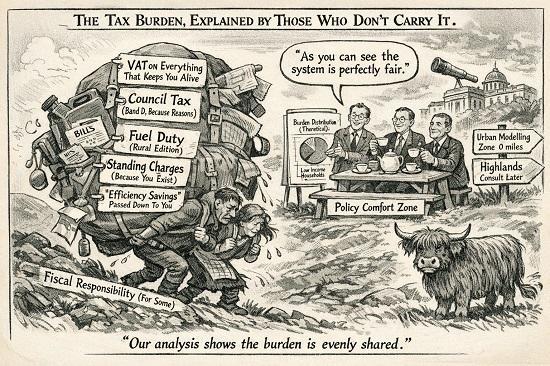
For years we've been told that Britain is a "high‑tax country", that the burden is crushing the wealthy, and that the nation's prosperity depends on easing the load at the top. But when you stop looking at headline income tax rates and start counting all the taxes people actually pays income tax, National Insurance, VAT, council tax, fuel duty, alcohol duty, and the rest. A very different picture emerges. One that anyone in the Highlands will recognise instantly as the lowest incomes are now paying even more taxes than you might think.
Because once you include the taxes that can't be avoided the ones baked into every litre of fuel, every loaf of bread, every electricity bill, and every council tax reminder it turns out the poorest households pay the highest effective tax rate in the UK. Not the richest. Not the "squeezed middle". The poorest.
And nowhere is that more obvious than in the Highlands, where the cost of living is higher, the wages are lower, and the tax system seems designed by someone who has never been north of Perth.
The Numbers Westminster Doesn't Like to Discuss
ONS data shows that the poorest 10% of households pay an astonishing 48% of their income in tax once everything is counted. That's not a typo. Nearly half of every pound they earn disappears into the Treasury via a mix of direct and indirect taxes.
The richest 10%, meanwhile, pay around 39%. And the very richest are those whose income comes from capital gains, dividends, and clever accountancy often pay far less than that. Some high‑income individuals pay effective rates in the low teens. A few pay less than someone working full‑time on minimum wage.
This is the part of the tax system that never makes it into the political leaflets.
Why the Poorest Pay the Most - A Highland Breakdown
VAT hits low incomes hardest
When you spend almost everything you earn just to get by, VAT becomes a tax on survival.
In the Highlands, where food, fuel, and essentials cost more, VAT quietly eats a bigger slice of every household budget.
Council tax is regressive by design
Council tax in the Highlands routinely takes 6-8% of income for low‑income households.
For the wealthy, it’s barely noticeable — often 1% or less.
And of course, the Band D rate in Highland is higher than in many wealthy southern councils, despite the smaller tax base and larger geography. A perfect example of "localism" meaning "you’re on your own".
Fuel duty punishes rural life
In London, fuel duty is a nudge to take the Tube.
In Caithness, it’s a tax on existing.
When your nearest GP, supermarket, or job is 20-60 miles away, fuel duty becomes a structural penalty for living where the government forgot to build infrastructure.
Wealth is taxed lightly — if at all
The UK taxes wages heavily but taxes wealth with the delicacy of a man dusting a Ming vase.
Capital gains are taxed below income. Dividends are treated gently. Inheritance tax is riddled with exemptions.
The result?
A crofter in Lybster pays a higher effective tax rate than a millionaire in Chelsea whose income comes from property portfolios.
The Great British Tax Illusion
Politicians love to talk about the "tax burden", but they rarely mention who actually carries it.
The UK tax system is progressive at the top of the payslip and regressive everywhere else.
It’s a U‑shaped curve:
The poorest pay the most
The middle pay less
The rich pay even less
The ultra‑rich pay the least of all
It’s a system that rewards wealth, penalises work, and hits rural communities hardest.
And yet every Budget speech begins with the same solemn ritual:
“We must protect hard‑working families.”
Usually followed by a policy that does the opposite.
A Highland Satire - The Taxman’s View from the Central Belt
If you were to imagine the UK tax system as a character, he’d be a polite civil servant from Edinburgh who insists he understands rural Scotland because he once spent a weekend in Aviemore.
He’d say things like:
“Of course VAT is fair — everyone pays the same rate.”
“Council tax is based on property values, so it’s progressive.”
“Fuel duty encourages greener choices.”
Meanwhile, a family in Thurso is paying more tax as a share of income than a banker in Knightsbridge, and the only “green choice” available is whether to plant potatoes or kale.
So Who Really Pays the Highest Tax Rate?
Not the wealthy.
Not the asset‑rich.
Not the people with accountants who can turn income into something more tax‑efficient.
It’s the households who spend every penny they earn.
It’s the people who can’t avoid VAT, can’t escape council tax, and can’t choose not to drive.
It’s the rural communities who pay more for everything and get less in return.
In short
The poorest pay the highest effective tax rate in the UK — and the Highlands feel it more than most.