Just in Time for Christmas: Royal Mail to Scrap Saturday Second?Class Deliveries
17th April 2026
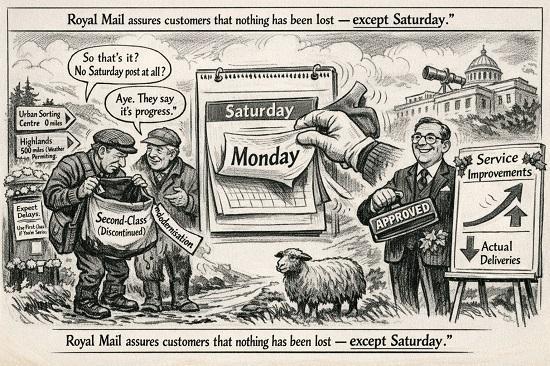
Royal Mail has confirmed that Saturday deliveries for second‑class post are being phased out, with full national rollout expected by December 2026 — a seasonal gift nobody asked for.
Under the new model, second‑class letters and bulk business mail will no longer arrive on Saturdays. Instead, they'll be delivered on an alternating weekday schedule, meaning a letter posted late in the week may not appear until Monday or even Tuesday.
First‑class letters, parcels, Special Delivery and tracked items will still arrive on Saturdays — but anything low‑priority is now officially very low‑priority.
Royal Mail argues the change is necessary because letter volumes have collapsed and Saturday delivery is too expensive to maintain. Ofcom has already approved the reform, and pilots are underway across the UK.
For rural areas like the Highlands, where Saturday post often fills the gap left by long distances and limited services, the shift will be felt more sharply. A second‑class letter posted on a Thursday may now take the scenic route arriving sometime after the weekend, weather permitting.
If you want Christmas cards to land on a Saturday, you'll need to pay first‑class or send them in November.
Having only recently put up the cost to send things by Royal Mail it seems they can find more ways to make sure a privatised service makes money.
Will scrapping Saturday second‑class deliveries cut salary costs?
Yes — because Royal Mail can reduce paid delivery hours
Saturday delivery requires:
Additional delivery rounds
Overtime or premium‑rate hours
Weekend staffing levels that are expensive to maintain
By removing a whole category of Saturday mail, Royal Mail can:
Reduce the number of delivery staff needed on Saturdays
Cut overtime
Shorten routes
Reassign staff to weekday parcel work (which is more profitable)
This is where the bulk of the savings come from.
But Royal Mail is not eliminating Saturday work entirely
Saturday first‑class and parcels still run, so:
Delivery staff still work Saturdays
Sorting offices still operate
Vans still go out
The saving is therefore partial, not total.
Think of it as trimming the wage bill, not chopping it.
The real financial driver is the collapse in letter volumes
Letter volumes have fallen by around 60% since 2005.
Royal Mail is legally required to deliver letters six days a week, but the economics no longer support it.
Cutting Saturday second‑class is a way to:
Reduce labour costs
Focus staff on parcels (where the money is)
Move toward a leaner Universal Service model
It's a cost‑saving measure disguised as a "modernisation".
Will it lead to fewer postal workers?
Almost certainly yes, over time.
Not through mass layoffs, but through:
Not replacing retirees
Reducing casual and temporary staff
Cutting overtime
Shrinking Saturday duties
Royal Mail has already said it expects "efficiency gains" — which is corporate code for fewer paid hours.
Highland angle
In rural areas like Caithness and Sutherland:
Delivery routes are long
Staffing is already thin
Saturday rounds help keep the service viable
Cutting Saturday second‑class may save Royal Mail money, but it risks:
Longer delays for rural mail
More pressure on already stretched delivery staff
A widening gap between urban and rural service levels
It’s another example of a national reform that hits the periphery harder than the centre.