Why Oil Prices May Stay High Even With the Strait of Hormuz Open: A Global Infrastructure War and Its Impact on the UK
18th April 2026
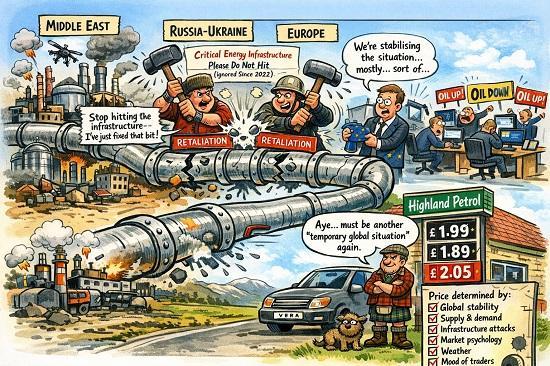
The reopening of the Strait of Hormuz during the current ceasefire has brought a moment of relief to global markets. Oil prices dipped below $100 a barrel, and analysts briefly speculated that the worst of the crisis might be easing.
But this optimism is fragile. Across the Middle East, North Africa, and Eastern Europe, oil and energy infrastructure is being attacked at a pace not seen in decades.
Even with the world's most important shipping corridor open, the global energy system is under pressure from multiple directions and that pressure is likely to keep UK petrol prices elevated and volatile.
The Strait of Hormuz Is Open But the Region Is Not Stable
Iranian officials have confirmed that the Strait of Hormuz is open for the duration of the ceasefire. This follows public statements from President Trump claiming that Iran had effectively conceded and that the waterway would remain open permanently. Iranian representatives have publicly contradicted several of these claims, stating that negotiations remain "preliminary" and that no long‑term agreement has been reached.
The strait's reopening has helped calm markets, but only temporarily. The underlying reality is that the region remains highly unstable, and attacks on oil infrastructure continue across several countries.
Attacks on Oil Installations Are Increasing Across Multiple Countries
In the past few weeks, there have been repeated strikes on:
Refineries
Export terminals
Oil storage sites
Pipelines
Gas processing facilities
These attacks have occurred in countries including Iraq, Syria, Yemen, and parts of North Africa. Each incident may seem isolated, but together they create a pattern: the energy system is being disrupted at multiple points simultaneously.
Even if tankers can sail freely through Hormuz, the oil they are meant to carry may not be produced, refined, or loaded on time.
This is why markets remain nervous.
Why Infrastructure Attacks Keep Oil Prices High
Physical supply is disrupted
When refineries or pipelines are hit, production slows or stops. Even short interruptions can tighten global supply.
Insurance and shipping costs rise
Tankers operating in conflict zones face higher war‑risk premiums. These costs are passed directly into the price of crude and refined products.
Traders price in future risk
Oil markets don’t wait for shortages. They respond to the possibility of escalation.
As long as infrastructure is being targeted, traders assume more disruption is coming.
Producers reduce output for safety
Companies often shut down facilities, evacuate staff, or delay maintenance when attacks occur nearby.
All of this keeps prices elevated even when the strait is open.
The Russia-Ukraine War: A Second Front in the Global Energy Conflict
While the Middle East dominates headlines, the Russia-Ukraine war continues to shape global energy markets in profound ways. Both sides have increasingly targeted each other’s energy infrastructure:
Ukraine has struck Russian oil refineries, fuel depots, and export terminals.
These attacks reduce Russia’s refining capacity and limit its ability to export diesel and other fuels.
Russia has attacked Ukrainian energy infrastructure, including power stations and fuel storage sites.
This forces Ukraine to import more energy from Europe, tightening supply across the continent.
These strikes have several global consequences:
Reduced Russian refining capacity
Russia is one of the world’s largest exporters of diesel. When its refineries are damaged, global diesel supply tightens — and diesel is the backbone of transport, agriculture, and logistics.
Higher European demand
When Ukraine’s infrastructure is hit, Europe must supply more electricity, gas, and refined fuel to keep the country running.
Increased competition for global cargoes
Europe, the UK, and parts of Asia all compete for the same refined products. Any disruption in Russia or Ukraine pushes prices up for everyone.
Market psychology
Just as in the Middle East, traders price in the risk of further escalation. The Russia–Ukraine conflict has become a long‑term source of uncertainty.
What This Means for UK Petrol Prices Over the Next Few Weeks
[/b]Prices may stabilise — but not fall sharply
The reopening of Hormuz has eased immediate panic, but the infrastructure attacks elsewhere act as a counterweight. UK forecourts may see small reductions, but dramatic drops are unlikely.
Volatility will remain high
Expect prices to move up and down week by week as new attacks or ceasefire developments emerge.
Diesel remains the biggest risk
Because Russia is a major diesel exporter, refinery attacks there have an outsized impact on UK diesel prices. Rural areas — where diesel vehicles dominate — will feel this most.
The UK’s reliance on imported refined fuel increases vulnerability
The UK imports a large share of its diesel, jet fuel, and petrol components.
If refineries in the Middle East or Russia are offline, the UK feels it quickly.
Rural Scotland faces a double premium
For regions like Caithness and the Highlands:
Transport costs are higher
Supply chains are longer
Competition between forecourts is limited
This means:
Price rises arrive faster
Price drops arrive slower
Average prices stay higher than the UK mean
Even small global disruptions can translate into noticeable local increases.
The Outcome
The Strait of Hormuz may be open, but the global energy system is under attack on multiple fronts. From Middle Eastern refineries to Russian oil terminals, infrastructure is being targeted in ways that keep markets on edge.
As long as these attacks continue — and as long as the Russia–Ukraine war remains a conflict where energy assets are routinely struck — oil and fuel prices will remain elevated and unpredictable.
For the UK, and especially for rural regions like the Highlands, this means a period of continued volatility. Prices may ease slightly in the short term, but the underlying risks point to a bumpy road ahead.