Britain’s Jobs Market Is Losing Steam: The Quiet Slowdown Behind the Headlines
21st April 2026
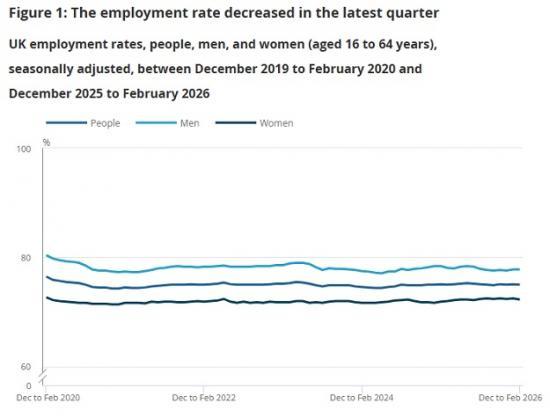
The latest labour market figures from the Office for National Statistics offer a picture that is easy to misread at first glance. There is no dramatic spike in unemployment, no sudden collapse in employment, no single figure that signals crisis.
And yet, taken together, the data from the April 2026 release point to something more subtle and arguably more concerning. A labour market that is steadily losing momentum.
Employment in the UK remains broadly stable, with around three-quarters of working-age adults in jobs. On the surface, that suggests resilience. But stability is not the same as strength. Growth has stalled, and the latest figures show a slight dip in employment levels. After several years of post-pandemic recovery, the jobs market appears to have reached a plateau.
Beneath this headline stability, the trends become more telling. The number of payrolled employees has been edging down, with tens of thousands fewer people on company payrolls compared with a year ago. Month by month, the declines are small, almost easy to ignore. But their persistence matters. It suggests that employers are no longer expanding their workforces and, in some cases, are quietly scaling back.
Unemployment, meanwhile, has ticked down slightly to just under 5 per cent. Ordinarily, that might be seen as good news. However, the context complicates the picture. The decline is not solely driven by people finding jobs; it also reflects a number of individuals stepping out of the labour market altogether. When fewer people are actively looking for work, the unemployment rate can fall even if job prospects are not improving. In that sense, the headline figure risks overstating the health of the market.
Perhaps the clearest signal of change comes from wages. Pay growth, which surged in the wake of inflationary pressures, is now slowing noticeably. Earnings are still rising, but at a much more modest pace than in recent years. For many workers, this means that real improvements in living standards are limited at best. The era of rapid nominal wage growth appears to be coming to an end.
At the same time, job vacancies have dropped to their lowest level in several years. This is a crucial indicator. Vacancies reflect employer demand for labour, and when they fall, it typically means fewer opportunities for jobseekers and less leverage for employees negotiating pay or conditions. The balance of power in the labour market is shifting—away from workers and back towards employers.
Taken together, these trends paint a coherent picture. Employment is flat, payroll numbers are slipping, wage growth is easing, and vacancies are declining. This is not a labour market in crisis, but it is no longer one in recovery either. It is, instead, a market in retreat from its recent highs—a gradual cooling rather than a sudden downturn.
The implications extend beyond the jobs market itself. A weaker labour market can feed into slower economic growth, reduced tax revenues, and increased pressure on public finances. It also has direct consequences for households. With fewer opportunities and slower wage growth, many workers may find it harder to improve their financial position. For those on lower incomes, this can mean continued reliance on state support to bridge the gap between earnings and living costs.
In that sense, the latest figures connect to a broader economic reality. Even as employment remains high by historical standards, the quality and security of work—and the wages it provides—are under strain. The labour market is not collapsing, but it is no longer carrying the momentum that once masked these underlying weaknesses.
The April 2026 report from the Office for National Statistics does not deliver a dramatic warning. Instead, it offers something quieter but no less important: evidence of a shift. Britain’s jobs market is no longer powering ahead. It is slowing, softening, and, in subtle ways, starting to turn.
Read the full ONS report 21 April 2026 HERE