Pay Rises Are Fading Fast: Britain’s Wage Squeeze Tightens Again
21st April 2026
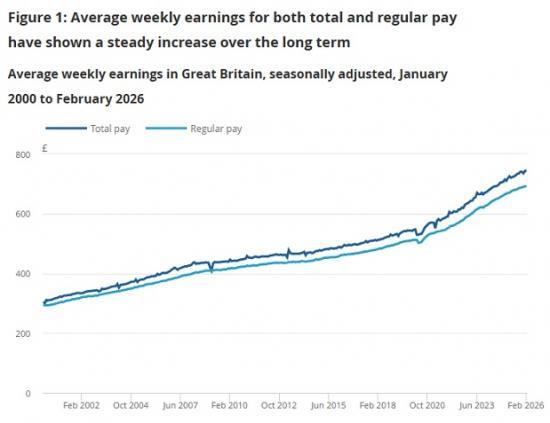
The latest earnings figures from the Office for National Statistics tell a story that will feel familiar to many households across the UK. Pay is still rising, but the momentum has gone. After a period of relatively strong wage growth driven by inflation and labour shortages, the tide is now turning. The April 2026 data on average weekly earnings points to a labour market where workers are steadily losing ground.
On paper, the numbers do not look alarming. Regular pay, excluding bonuses, is still increasing at an annual rate of around 3.6 per cent. But that headline figure masks a clear slowdown. Only months ago, wage growth was comfortably above 4 per cent, and before that it exceeded 5 per cent. The direction of travel is unmistakable - earnings growth is cooling, and doing so at a steady pace.
Once inflation is taken into account, the picture becomes even less encouraging. Real pay—what wages are actually worth in terms of purchasing power is barely increasing. For many workers, the difference is marginal, amounting to little more than a few pounds a week. In practical terms, this means that living standards are stagnating. Pay packets may be larger in nominal terms, but they are not stretching much further.
The slowdown is particularly evident in the private sector, where the majority of the workforce is employed. Here, wage growth has weakened more sharply, dropping to levels not seen for several years. This is a significant signal. Private sector pay tends to reflect underlying economic conditions more directly than public sector wages, which are often influenced by policy decisions and pay settlements. When private employers start to rein in pay increases, it usually points to softer demand and greater caution about the future.
Public sector wages, by contrast, have held up better in the short term. However, this is partly due to one-off pay deals and timing effects rather than a sustained upward trend. It would be a mistake to interpret this as a sign of lasting strength. As these temporary factors fade, the gap between public and private sector pay growth is likely to narrow once again.
The broader trend over the past year reinforces the point. Wage growth has declined from above 5 per cent to below 4 per cent, and now sits closer to the mid-3 per cent range. This is not a sudden drop but a gradual easing. Yet it is precisely this steady decline that makes it significant. It suggests that the forces which once drove rapid pay increases, such as tight labour markets and inflationary pressures, are weakening.
For workers, the implications are immediate. Slower wage growth reduces the ability to absorb rising costs, limits improvements in living standards, and weakens financial resilience. For those on lower incomes, the effects are even more pronounced. When pay rises shrink, the gap between earnings and everyday expenses becomes harder to bridge, increasing reliance on other forms of support.
For the wider economy, the consequences are more complex. Cooling wage growth may help ease inflation, which in turn could influence interest rate decisions. But it also reflects a loss of momentum in the labour market. Employers are becoming more cautious, opportunities for higher pay are diminishing, and the balance of power is shifting away from workers.
The latest figures from the Office for National Statistics do not point to an immediate crisis. Instead, they highlight a quieter but more persistent challenge. Britain’s wage growth is no longer keeping pace with expectations, and the gains made in recent years are beginning to fade.
The headline may still say that pay is rising. The reality, for many, is that it is rising more slowly—and that is starting to make all the difference.
Read the full ONS report HERE