Britain’s Changing Household Landscape: Fewer Traditional Families, More Diverse Living Arrangements
21st April 2026
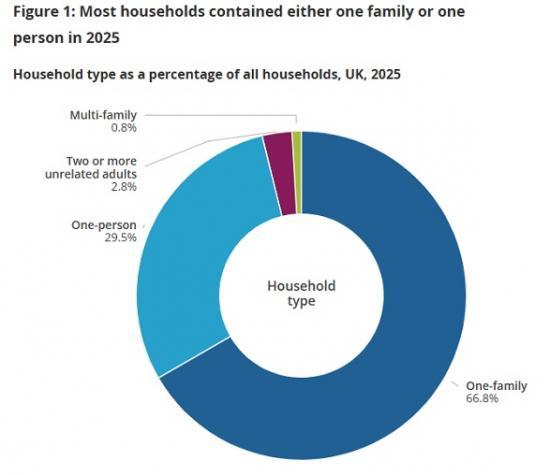
The latest Families and Households in the UK - 2025 report from the Office for National Statistics reveals a country whose living arrangements are gradually but steadily changing. While the overall structure of British households still leans towards traditional family units, long-term shifts in how people live together or alone continue to reshape the social fabric.
At the most basic level, the UK now has around 29 million households, a figure that has grown broadly in line with population growth. The average household contains just over two people, reflecting a long-standing trend towards smaller household sizes. Despite this, the dominant household type remains the “one-family household,” accounting for roughly two-thirds of all households.
The Decline of the Traditional Married-Couple Household
Married couples remain the most common family type, making up around 65% of all families in 2025. However, this share has been slowly declining over the past decade. The fall is not dramatic, but it is consistent, reflecting broader social changes in how people form relationships and households.
At the same time, cohabiting couples and civil partnerships have increased slightly, although married couples still overwhelmingly dominate. The key shift is not the disappearance of the traditional family, but its gradual loss of dominance within a more diverse range of living arrangements.
More People Living Alone
One of the most striking findings is the continued scale of single-person households. Around 29% of UK households are now single-person homes, amounting to roughly 8.6 million people.
This trend is particularly pronounced among older age groups:
Nearly half of people living alone are aged 65 or over
This reflects both increased life expectancy and the likelihood of surviving partners living independently later in life
While living alone is often associated with older people, it is also a feature of younger adults in urban areas, though the ageing population remains the main driver of the trend.
Young Adults Staying at Home Longer
The report also highlights a continued rise in young adults living with their parents. Nearly three in ten people aged 20–34 now live in the parental home, a higher proportion than a decade ago. This reflects broader economic and social pressures, including:
high housing costs
delayed family formation
greater flexibility in modern lifestyles
The result is a shift in the traditional timeline of adulthood, with independence often arriving later than in previous generations.
The Rise of Lone-Parent and Non-Traditional Families
Around 16% of families are lone-parent households, a figure that has remained broadly stable over the last decade. However, there has been a gradual increase in the number of lone-parent families with older, non-dependent children living at home.
This reflects another subtle but important shift in hat family structures are lasting longer within the same household, rather than dissolving once children reach adulthood.
A More Fluid Picture of Family Life
Taken together, the data points to a society where:
the traditional married-couple household is still dominant, but less so than before
more people are living alone, especially older adults
young adults are staying in the parental home for longer
family forms are becoming more varied and flexible
The overall number of families has risen, but the composition of those families is gradually diversifying.
Slow Change, Lasting Impact
The 2025 report from the Office for National Statistics does not show sudden disruption, but rather steady, long-term transformation. Britain is not abandoning the traditional family model, but it is increasingly no longer defined by it.
Instead, the picture that emerges is of a country where:
family life is more fragmented, more flexible, and more individually shaped than at any point in recent history.
And while these changes are gradual, their cumulative effect is significant—reshaping housing demand, welfare needs, and the way society understands what a “household” actually is.
Read he full ONS report HERE