Scotland’s Labour Market: Stable on Paper Stagnant in Reality
21st April 2026
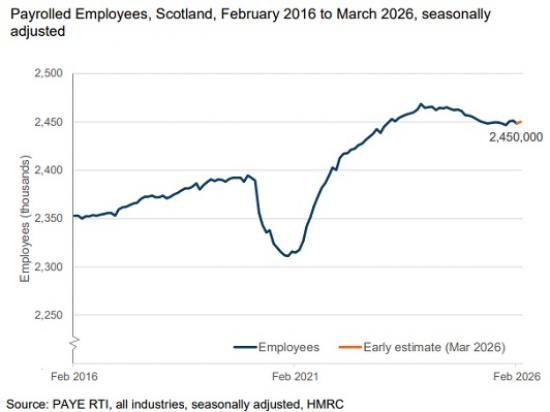
The latest labour market update from the Scottish Government presents a picture that is, on the surface, reassuringly stable. Employment levels remain broadly steady, unemployment is relatively low by historical standards, and there are no dramatic swings in the headline figures.
But beneath that stability lies a more important story: Scotland’s labour market is not deteriorating, but it is also not gaining meaningful momentum.
According to the report, Scotland’s employment rate stands at around 74–75%, broadly in line with recent years and only slightly below the UK average. Unemployment is estimated at roughly 3.9–4.2%, again relatively moderate and not showing signs of sharp deterioration. At first glance, these figures suggest a labour market that is functioning reasonably well.
However, the most persistent structural feature of Scotland’s labour market is not employment or unemployment, but economic inactivity. Around 22% of working-age adults in Scotland are neither in work nor actively seeking employment. This figure has remained stubbornly high over time and is consistently above the UK average. It is this inactivity rate that defines much of Scotland’s labour market challenge.
In simple terms, Scotland is not struggling primarily because too many people cannot find jobs—it is struggling because a significant share of the working-age population is not participating in the labour market at all. The reasons behind this are complex and include long-term health conditions, caring responsibilities, early retirement, and disengagement from work after periods of ill health or unemployment. Whatever the cause, the effect is the same: a reduced pool of available labour.
Employment itself, at just over 2.6 million people, has shown only minor changes over the latest quarterly and annual periods. The report notes that most movements are not statistically significant, reinforcing the idea of a labour market that is broadly flat rather than expanding or contracting in any meaningful way. Similarly, unemployment numbers have fluctuated only slightly, suggesting no major shift in hiring or redundancies.
This pattern points to a labour market that is essentially static rather than dynamic. Jobs are neither being created nor lost at scale, and participation is not significantly improving. Instead, Scotland appears to be operating in a kind of equilibrium—stable, but not progressing.
Another important feature is how Scotland compares with the wider UK. While overall UK employment rates remain slightly higher and inactivity slightly lower, Scotland consistently sits close to—but marginally weaker than—the UK average. The gap is not dramatic, but it is persistent. This suggests structural differences rather than short-term variation.
Recent data from the Scottish Government also highlights modest changes in payrolled employment, with slight annual declines in some estimates. While not large enough to signal a downturn, they reinforce the broader theme of weak labour market momentum rather than strong growth.
Taken together, the April 2026 report does not describe a crisis in Scotland’s labour market. Instead, it describes something more subtle but equally important: a system that is stable but underperforming relative to its potential.
Employment is steady, unemployment is contained, but inactivity remains high and structural. The result is a labour market that is neither breaking down nor building up—simply holding its position.
In that sense, Scotland’s challenge is not immediate instability, but long-term stagnation. And unless participation rates begin to improve, that stagnation risks becoming the defining feature of its labour market in the years ahead.
Readthe full Scottish Government report HERE
Pdf 27 Pages