Ten years on from Parcelhero’s ‘Death of the High Street’ report, are our town centres still dying? YES
23rd April 2026
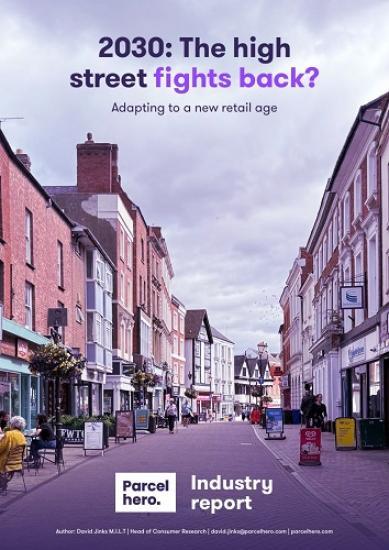
Parcelhero’s influential report ‘2030: The Death of the High Street’ was released in 2016. It forecast huge changes to our town centres because of the continued rise of e-commerce. A decade on, Parcelhero has published a new report: ‘2030: The High Street Fights Back? Adapting to a New Retail Age’. Are Parcelhero’s original predictions still on course or are physical stores staging a comeback?
In 2016, the home delivery expert Parcelhero released its highly influential report ‘2030: The Death of the High Street’. It predicted 100,000 stores then trading would close between 2016 and 2030, that many of retail’s biggest names would disappear and that whole sections of retail such as department stores, fashion chains, bank branches and newsagents would be decimated.
Such was its impact that the report was even discussed in Parliament. Now, ten years later, Parcelhero has launched an all-new report ‘2030: The High Street Fights Back? Adapting to a New Retail Age’. With 2030 just four years away, Parcelhero’s new study examines whether the original predictions were accurate. Did Covid speed up the High Street’s demise or are town centres and physical stores fighting back in ways not envisaged in 2016?
The lead author of both reports, David Jinks M.I.L.T., Parcelhero’s Head of Consumer Research, says: ‘When we released our first study, 2030 seemed a long way off. With just four years remaining, now is the ideal time to see if our town centres continue to wither on the vine or if there are green shoots we didn’t foresee ten years ago.
‘At first glance, I’m afraid our new report “2030: The High Street Fights Back?” is far from encouraging reading. That question mark in the title is not there for nothing. The first report forecast 100,000 store closures by 2030. As our new report reveals, in some ways the situation is even worse than we feared. Since 2016, an estimated 122,682 physical stores have already closed down.
‘In our original report, “2030: The Death of the High Street”, we forecast the demise of many household names. Sure enough, since 2016, many big brands have disappeared from our town centres or have entered administration, including Jaeger, Toys R’ Us, Maplin, Mothercare, Thomas Cook, Debenhams, Beales, Laura Ashley, Harveys Furniture, McColl’s, Paperchase, Homebase, Ted Baker, Oddbins and Lloyds Pharmacy. This year alone, Claire’s, The Original Factory Shop, Russell & Bromley and Quiz have fallen into administration, and it’s only April.
‘Let’s start our roll call of the departed with department stores. Our new report reveals that, since 2016, department stores have been decimated. House of Fraser fell into administration in August 2018. Sports Direct bought the business but the number of stores has more than halved from 59 to 23 today. Debenhams had 165 department stores but, following its liquidation, all had closed by June 2021 (though Boohoo bought the website and has adopted the brand online). Beales had 23 stores in 2019 and all of them are now closed. Since 2016, over 83% of UK department store space has gone.
‘Similarly, in our first report, we said, “Online retailers are stripping the shirts from the back of High Street clothing stores.” Ten years on, thousands of clothing stores have closed. Arcadia Group alone closed over 200. In 2016, it would have been hard to believe that the list of household names entering administration would include L K Bennett, Karen Millen, Jack Wills, Cath Kidston, Oasis, Warehouse, Quiz, TM Lewin, Edinburgh Woollen Mill, Topshop, Dorothy Perkins and Burtons.
‘Town centre newsagents, stationers and tobacconists have also disappeared in smoke. In our original report, we said even the famous WHSmith brand “cannot be saved by colouring books alone”. Sure enough, WHSmith sold its struggling High Street stores to Modella Capital and they have been rebranded TGJones. Paperchase went into administration at the end of January 2023 and you’ll only find its cards in Tesco stores. McColl's has also vanished.
‘Nor can you bank on still having a High Street bank. “2030: The Death of the High Street” stated, “As we move to online banking, around 9,000 bank and building society branches have been closed since 1989 – and more closures are planned.” Indeed, that proved to be the case. “2030: The High Street Fights Back?” reveals that around 6,660 more bank branches closed between 2016 and 2025 and there are many more on the way.
‘Our new report goes on to feature many other categories where our original predictions were all too true. However, our crystal ball was not infallible! In “The Death of the High Street”, we predicted that bookshops were nearing their final chapter. We said, “The traditional High Street book store industry is collapsing at 2.3% a year, with just 1,071 retail businesses remaining.” While there has been a decline, the current number of independent bookshops alone still stands at 1,052. Bookshops have turned over a new leaf.
‘In terms of online growth, back in mid-2016, online spending accounted for just 14.2% of all retail spending. Our first report’s prediction that, by 2030, 40% of all retail spending would be online looked like a brave call (or a remarkably gloomy one, depending on your point of view). However, just five years later, at the height of the Covid pandemic in February 2021, online sales came within 4.4% of taking that 40% predicted share some nine years early. Online sales peaked at 35.6% of all retail trade as shoppers fled the High Street.
‘However, as our new report documents, Covid ultimately created an e-commerce bubble that burst – a Black Swan event no one could have predicted back in 2016. Many online retailers gambled on the continued exponential growth of online shopping post-Covid. That didn’t happen and many of e-commerce’s biggest stars were caught out – the online grocery giant Ocado has tumbled out of the FTSE 100 and even Asos and Boohoo have had their reasons to cry. Food delivery services such as Jiffy, Gorillas and Getir have all disappeared. Even the one-time darling of online fast fashion, Missguided, made a misguided expansion and was forced to appoint administrators in 2022.
‘Don’t run away with the idea that e-commerce is on its way out and the High Street will return to its former glory, however. Our latest report reveals that online sales have fallen back since 2021 but they remain significantly higher than in 2016, at around 28% of the entire market. In February 2026, online held 28.2% of the total retail spend, for example. The jury is still out on our predicted e-commerce share of 40% by 2030.
‘So have online’s growing pains been the High Street’s gain? Well, as our new report’s title “2030: The High Street Fights Back?” hints, there have been some encouraging signs. In 2024, the fastest-growing category was convenience stores, as large supermarket chains accelerated growth in this expanding market by opening increasing numbers of smaller stores.
Likewise, coffee shops also saw more than one net opening per week and cake shops also swelled in numbers. So at least part of our High Street looks set to enjoy a sweet future.
While we have lost 122,682 physical stores between 2017 and the end of 2025, that is not a net loss. That number is harder to determine, but will be lower, as some churn is natural. Even so, as our report highlights, many more shops have closed than opened, especially in key sectors such as department stores.
This still threatens the survival of some High Streets and shopping arcades. The High Street may not have reached a dead end by 2030 but, in this new age of retail, it will have arrived at its biggest crossroads.
You can read our full new report at https://newsroom.parcelhero.com/the-high-street-fights-back-final.pdf
Pdf 22 Pages
The debate in UK parliament in June 2018 on retail issues