From Condoms to Cars: Prices Are Going Up… So Are We Heading for a Baby Boom? Or Not
23rd April 2026
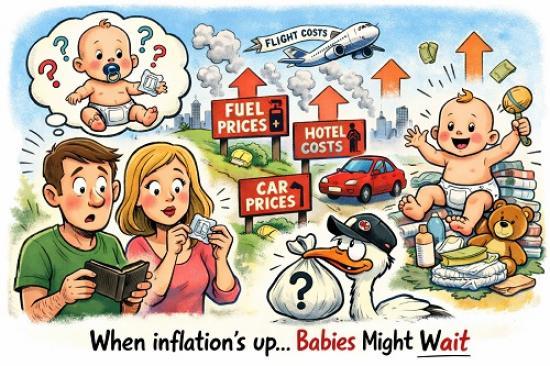
There was a time when inflation meant your weekly shop crept up a few pounds and you muttered about it over tea. In 2026, inflation has taken a more comprehensive approach. It’s no longer just groceries or fuel. It’s flights, hotels, rent, restaurant meals and now, somewhat awkwardly, even condoms.
Yes, really.
Recent reports suggest that the humble prophylactic—once the quiet hero of responsible decision-making—is getting caught up in the same global forces pushing up the price of everything else. Oil prices rise, petrochemicals get more expensive, packaging costs increase, shipping becomes pricier… and suddenly your Saturday night essentials are subject to the same economic headwinds as a transatlantic flight.
Which raises an obvious, if slightly mischievous, question:
If everything is getting more expensive… including contraception… are we about to see a baby boom?
Inflation has entered the bedroom
The idea sounds like the setup to a bad joke, but the logic—at least on the surface—is not entirely absurd.
Condoms, like many everyday products, rely on global supply chains. Materials, manufacturing, transport, packaging—all of it is linked, directly or indirectly, to energy prices. As oil and gas costs rise, so too does the cost of producing and distributing these items.
Now, before we descend into full tabloid panic, let’s be clear: this doesn’t mean people are suddenly abandoning contraception en masse because prices have ticked up a few pounds. This is not a Victorian crisis of scarcity.
But it does highlight something interesting: inflation is now touching parts of everyday life that used to feel immune.
And that’s where things get… sociologically intriguing.
From cars to contraception - everything is connected
Think about the broader picture. The same forces pushing up the cost of:
Airline tickets
Hotel rooms
Rental housing
Food and energy
…are also nudging up the price of smaller, less-discussed items.
It’s all part of the same chain reaction:
energy costs rise to production costs rise to prices rise to consumers adjust behaviour
Usually, that adjustment means cutting back, shopping around, or delaying purchases.
But when it comes to something like contraception, behaviour is not purely economic—it’s human, unpredictable, and occasionally illogical.
So… will higher prices mean more babies? Or Not
Let’s be honest: probably not—at least not in any dramatic, measurable way.
If anything, history suggests the opposite. When the cost of living rises:
People tend to delay having children
Birth rates often fall, not rise
Financial uncertainty leads to more cautious decisions
We’ve seen this pattern after the 2008 Financial Crisis, and again during the COVID-19 pandemic.
So if you’re expecting a sudden surge of 2027 “inflation babies,” you may be disappointed.
But human behaviour isn’t always rational
That said, economics doesn’t account for everything.
There’s always a small space where logic gives way to reality:
“We’ll just make do this once”
“It’ll be fine”
“What’s the worst that could happen?”
History, of course, suggests the answer to that last question is: quite a lot, actually.
So while we’re unlikely to see a statistically significant baby boom driven by rising condom prices, it would be unwise to assume absolutely no effect at all.
Let’s just say: inflation has a way of showing up in unexpected places.
The bigger story: inflation everywhere
The more important point is not about babies—it’s about reach.
What this slightly tongue-in-cheek scenario really illustrates is how deep and wide current inflationary pressures have become.
We are no longer dealing with isolated price increases. Instead, we’re seeing:
A travel sector where flights and hotels are rising together
A housing market under sustained pressure
Everyday goods quietly becoming more expensive
Even the most mundane purchases reflecting global geopolitics
From booking a holiday to buying dinner to… well, planning your evening, the same economic forces are at work.
When inflation reaches from cars to condoms, it’s a sign that no part of daily life is entirely untouched. Whether or not it leads to a baby boom is almost beside the point—the real story is how far the ripple effects now travel.
Still, just in case, it might be wise to keep an eye on birth statistics in about nine months’ time.
You know… purely in the interest of economic research.