Why the Bank of Japan Is Fighting the Yen and What It Reveals About a Wider Asian Currency Problem
3rd May 2026
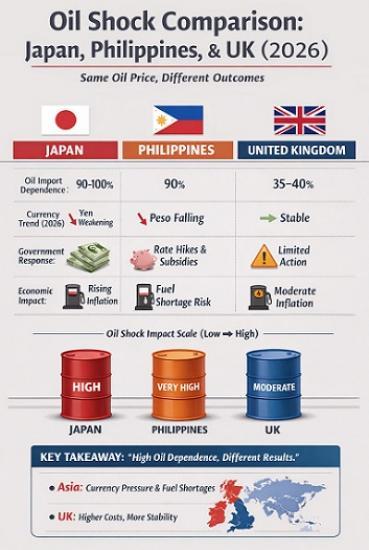
In recent months, the Bank of Japan has spent tens of billions of dollars intervening in currency markets to support the Japanese yen. At first glance, this may look like a technical financial issue. In reality, it is deeply connected to the same forces driving higher oil costs and economic strain across Asia.
To understand what is happening, you have to connect three pieces: oil prices, import dependence, and currency pressure.
A Weak Currency in a High-Oil-Price World
As discussed earlier, global oil prices may be set by benchmarks, but Asian countries often pay a higher effective price per barrel due to shipping costs, supply disruptions, and competition for cargoes. This matters enormously for Japan.
Japan imports almost all of its energy, much of it from the Middle East. When oil prices rise, Japan must buy more oil in US dollars, increasing demand for dollars and pushing the yen downward.
This is exactly what has been happening in 2026. The yen has fallen to multi-decade lows, even breaching levels around 160 per dollar, prompting emergency action from policymakers.
Why the Bank of Japan Is Intervening
To stop the currency from falling further, the Bank of Japan has been:
Selling US dollar reserves
Buying yen in global markets
Recent interventions are estimated at roughly $35 billion in a single move, highlighting the scale of the problem.
The goal is not to permanently strengthen the yen, but to slow its decline and prevent instability.
Why is that so important?
Because a weak currency makes imports even more expensive. For a country like Japan, that means:
Higher energy bills
Rising food prices
Increased inflation
In short, the falling yen amplifies the very oil shock that caused it.
The Feedback Loop: Oil Currency Inflation
This creates a dangerous cycle:
Oil prices rise globally
Japan pays more (often at a premium)
More dollars are needed → yen weakens
Imports become even more expensive
Inflation rises
Central bank intervenes
Despite intervention, analysts warn that without broader changes—such as higher interest rates or lower oil prices—the yen may remain under pressure.
This Isn’t Just Japan A Wider Pattern
Japan is the most visible case, but it is not alone. Several Asian economies are facing similar currency and energy pressures.
South and Southeast Asia
Countries like Pakistan and Philippines have seen their currencies weaken significantly as oil import costs surged.
The Philippine peso fell to record lows during the 2026 energy shock.
Pakistan introduced emergency fuel-saving measures and reduced working weeks to cope with rising costs.
These are not just financial issues—they directly affect daily life.
Energy Crisis Economic Disruption
In some countries, the impact has gone beyond currency depreciation:
Bangladesh shortened business hours and closed shops early to conserve energy ()
Sri Lanka introduced fuel rationing and four-day work weeks ()
Nepal rationed cooking gas supplies ()
These measures show how quickly an oil shock can translate into real economic constraints.
Why Europe Is Less Affected
This brings us back to your original comparison.
The UK and Europe face higher fuel prices too—but they rarely experience:
Currency collapse
Fuel rationing
Shortened working weeks
Why?
Because they are structurally more resilient:
More diversified energy sources (renewables, nuclear, gas)
Stronger currencies and financial systems
Lower reliance on imported oil relative to total energy use
Greater ability to absorb price shocks without destabilising the currency
Even when oil prices rise, the economic effects tend to show up mainly as higher costs, not systemic disruption.
A Regional Vulnerability
The situation unfolding in Japan highlights a broader truth:
Oil is not just a commodity—it is a currency risk multiplier.
For highly import-dependent Asian economies, rising oil prices don’t just increase costs.
They:
Weaken currencies
Drive inflation
Force government intervention
In extreme cases, disrupt daily economic activity
Japan’s currency interventions are therefore not an isolated event. They are a visible symptom of a deeper structural issue shared across much of Asia.
The Bank of Japan’s efforts to prop up the yen are part of a much larger story—one that links global oil markets to currency stability and economic resilience.
While oil prices are set globally, their consequences are not evenly distributed. In Asia, where dependence on imported energy is high, rising prices can trigger a chain reaction that affects everything from exchange rates to working hours.
In contrast, Europe’s more diversified energy systems and stronger financial buffers allow it to absorb the same shock with far fewer disruptions.
Understanding this difference is key to understanding today’s global economy—and why the same oil price can produce very different outcomes across regions.