The Grand Old Duke of Oil: Marched Above $110, Then Marched Back Down Again
6th May 2026
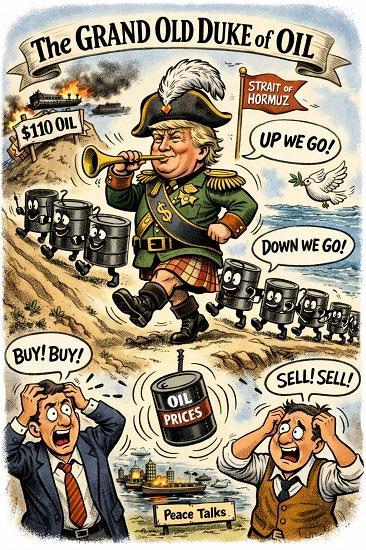
For weeks the global oil market has looked like a children’s rhyme acted out on a geopolitical stage. Prices were marched up the hill by fear, conflict and uncertainty and then marched down again the moment Washington hinted at a pause. But unlike the nursery tale, the stakes here are not wooden soldiers but fuel bills, supply chains and the economic stability of regions like the Highlands.
The latest movements in Brent crude briefly dipping below $100 before rebounding tell a story of a market that is no longer driven by fundamentals alone. It is driven by political choreography, and right now the conductor is the White House.
The Climb: How Oil Was Marched Up the Hill
Oil surged above $112 per barrel after a series of US strikes on Iranian energy infrastructure and escalating attacks around the Strait of Hormuz. Traders priced in:
the risk of a wider regional conflict
the possibility of disrupted tanker traffic
fears that Iran might retaliate by targeting shipping lanes
With Hormuz handling roughly 20% of global oil flows, even a hint of instability sends prices soaring. And soar they did.
For the Highlands, where fuel costs already carry a rural premium, every spike lands harder. Hauliers, crofters, fish processors, and ordinary households feel the shock long before London notices.
The Descent: Marched Back Down Again
Then came the surprise: President Trump announced a five‑day halt on US strikes, describing talks with Iran as “productive.” Markets reacted instantly.
Brent crude fell almost 11% in a single day, briefly slipping under $100.
Why the sudden drop?
A pause in military action reduced the “war‑risk premium.”
Traders took profits after the steep climb.
Hopes — however fragile — emerged that escalation might be avoided.
It was a classic case of marching the market back down the hill, even if only for a moment.
The New Twist: Hormuz Tensions Return
But the rhyme didn’t end there. Trump’s latest move — a high‑profile plan to “restore freedom of navigation” in the Strait of Hormuz — has pushed prices back upward.
The reasons are clear:
Iran rejected the plan, calling it a breach of the ceasefire.
Attacks on tankers continue, including reports of “unknown projectiles.”
Shipping flows remain at only a fraction of normal levels.
Analysts warn that if disruption persists, prices could exceed their 2008 record.
In other words: the market is being marched up the hill again, and this time the slope looks steeper.
What This Means for the Highlands
For Caithness, Sutherland and the wider Highlands, oil volatility is not an abstract global drama. It translates directly into:
higher diesel and petrol prices
increased transport costs for goods
pressure on household budgets
rising costs for councils already struggling with debt
uncertainty for local businesses dependent on fuel‑intensive logistics
When oil jumps, rural Scotland pays first and pays hardest.
The Outlook: A Market on a Yo‑Yo String
The pattern is now familiar:
Escalation - prices surge
Pause or diplomatic hint - prices fall
New tension or policy shift - prices surge again
This is not a stable market. It is a geopolitical yo‑yo, and the string is held by leaders whose decisions can move billions of dollars with a single statement.
Short dips below $100 are possible, but sustained prices below that level are unlikely while Hormuz remains disrupted and no US–Iran agreement is in sight.
The Nursery Rhyme Economy
The Grand Old Duke of York marched his men up and down the hill for no clear purpose. Today’s oil market feels much the same except the consequences are real, and they land on households, businesses and councils already under strain.
Until the Strait of Hormuz stabilises, expect more marching up when tensions rise, down when diplomacy flickers, and up again the moment hope fades.