What the TG Jones collapse tells us about the future of High Streets
7th May 2026
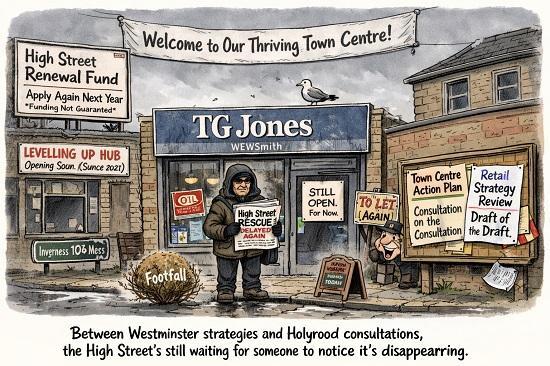
The near‑collapse of TG Jones — the rebranded WH Smith high‑street chain is more than a corporate misstep. It is a case study in the fragility of the modern High Street, especially in rural Scotland where every closure lands harder and lasts longer.
When a 234‑year old retailer with national brand recognition cannot survive a rebrand and a year of weak trading, it exposes the deeper truth. The High Street is no longer a self‑sustaining ecosystem. It is a life‑support patient.
The High Street has lost its anchor stores — and TG Jones was one of the last
For decades, WH Smith acted as a stabiliser: books, stationery, newspapers, travel goods, a Post Office counter, and a predictable presence in towns where retail choice was already thin.
Its retreat mirrors the earlier collapse of:
Debenhams
BHS
Wilko
M&Co
Each time an anchor goes, footfall drops, neighbouring shops suffer, and the spiral deepens.
TG Jones’ potential closure of up to 150 stores accelerates that spiral.
The economics of the High Street no longer add up
The TG Jones restructuring statement reads like a diagnosis of the entire sector:
High rents
Low footfall
Rising energy and staffing costs
Weak consumer spending
Landlords unwilling to cut rents
A business model built for 1995, not 2026
If a national chain with scale cannot make the numbers work, small independents have even less room to manoeuvre.
The rebrand failure shows how fragile customer loyalty has become
The shift from WH Smith to TG Jones was meant to modernise the brand.
Instead, it severed the emotional connection customers had with a familiar name.
This matters because High Streets now rely on habit, not necessity.
Break the habit, and the customer disappears.
Rural Scotland is hit hardest
In places like Highland and the islands, a WH Smith/TG Jones store is not just a retailer — it is:
A stationery supplier
A bookshop
A parcel counter
A newsagent
A place to buy travel essentials without a 100‑mile round trip
When these stores close, the gap is not filled.
It becomes another boarded‑up frontage, another reason for people to shop online, another blow to community confidence.
The High Street is shifting from retail to services — but too slowly
The future High Street will be built around:
Health and social care
Leisure
Food and drink
Community hubs
Hybrid workspaces
Local makers and micro‑retail
But the transition is uneven.
Many councils lack the capital to repurpose empty units.
Landlords cling to unrealistic rent expectations.
And national chains are retreating faster than new uses can replace them.
The TG Jones crisis shows the High Street is now a “confidence economy”
Once confidence goes — among landlords, retailers, or customers — decline accelerates.
TG Jones’ warning that landlords may “take the keys back” rather than cut rents is a sign of a market that no longer believes in its own future.
The TG Jones story is not about one retailer losing its way. It is about a High Street model that no longer fits the world we live in. The collapse of footfall, the rise of online shopping, the weight of fixed costs, and the fragility of consumer confidence have combined into a structural crisis. Rural Scotland feels this first and feels it hardest.
If up to 150 TG Jones stores close, it will not simply be the end of a rebrand gone wrong. It will be another chapter in the long unravelling of the British High Street — a reminder that without bold intervention, reinvention, and realistic rents, the High Street will continue to hollow out, one familiar name at a time.