Brexit and the UK Economy - A Decade of Slow?Burn Damage
12th May 2026
When the United Kingdom voted to leave the European Union in 2016, the economic consequences were fiercely debated.
Supporters predicted a surge in global trade, regulatory freedom, and renewed national dynamism.
Critics warned of trade barriers, investment flight, and long‑term economic decline. Nearly a decade later, the evidence is clearer than at any point since the referendum.
Brexit has imposed a large, measurable, and persistent economic cost on the UK, one that continues to shape growth, trade, productivity, and living standards.
This is not a political judgement. It is the conclusion of the UK’s own fiscal watchdog, the Office for Budget Responsibility (OBR), and a wide range of independent research institutions. The story that emerges is one of slow‑burn economic damage — not a dramatic collapse, but a steady erosion of national economic capacity.
The Scale of the Impact: A Smaller Economy Than It Should Be
The most important question is simple: How much smaller is the UK economy because of Brexit?
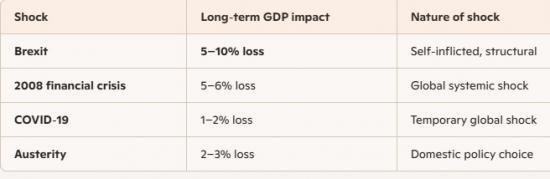
The answer, according to the OBR, LSE, CEPR, and NBER, is between 5% and 10% of GDP.
That is not a forecast — it is a measured loss relative to where the UK would likely have been had it remained in the EU.
A 5–10% GDP gap is enormous. It is larger than the long‑term economic damage from the COVID‑19 pandemic and comparable to the scarring from the 2008 financial crisis. Unlike those shocks, however, Brexit was self‑imposed.
The OBR estimates that UK trade volumes are 15% lower than they would have been, and productivity is 4% lower. These are structural losses, not temporary fluctuations.
Trade: The Return of Friction
The UK’s departure from the EU single market and customs union introduced new non‑tariff barriers — paperwork, checks, regulatory divergence — that have reduced trade intensity.
Key effects include:
UK exports to the EU have grown more slowly than exports from comparable economies.
Small exporters have been hit hardest, with many ceasing EU trade entirely.
Food imports face higher costs due to sanitary and phytosanitary checks.
Services — 80% of the UK economy — lost automatic market access.
The result is a permanent reduction in trade openness, which economists consistently link to lower productivity and slower wage growth.
Investment: A Decade of Hesitation
Investment is the engine of future growth. Since 2016, UK business investment has been:
12–18% lower than it would have been without Brexit (NBER, CEPR).
The weakest in the G7 for most of the post‑referendum period.
Depressed by uncertainty over regulation, market access, and future trade deals.
This investment drought has compounded the UK’s long‑standing productivity problem. Without investment, productivity stalls; without productivity, wages stagnate.
Labour Market: A Smaller, Less Flexible Workforce
Ending free movement reduced the supply of workers in key sectors:
agriculture
hospitality
social care
construction
logistics
The result has been:
higher labour costs
persistent shortages
reduced output in labour‑intensive industries
The Bank of England has repeatedly noted that post‑Brexit labour shortages have contributed to higher inflation, forcing interest rates higher than they might otherwise have been.
Food Prices: A Quiet but Significant Shock
One of the clearest impacts has been on food prices.
LSE’s Centre for Economic Performance finds that Brexit has:
increased UK food prices by 3–6%,
with the effect continuing to accumulate as new checks are phased in.
This is because non‑tariff barriers — rules‑of‑origin checks, veterinary paperwork, customs declarations — add cost at every stage of the supply chain.
For rural areas like Caithness, where transport costs are already high, this effect is magnified.
Why the Impact Took Years to Become Visible
Brexit was not a single event. It was a process:
2016–2019: uncertainty, investment freeze
2020: exit from the single market
2021–2024: gradual introduction of border checks
2025–2026: full implementation of UK import controls
Because the shock unfolded slowly, the economic damage accumulated quietly. There was no dramatic collapse — just a steady divergence from the growth path the UK had been on.
Economists call this a counterfactual loss: the UK grew, but it grew less than it would have.
Brexit is therefore one of the two largest economic shocks of the last 30 years, and the largest one the UK chose for itself.
The Broader Consequences: A Less Competitive Economy
The cumulative effects of reduced trade, lower investment, labour shortages, and regulatory divergence have made the UK:
less attractive to foreign investors
less integrated into global supply chains
less productive
more inflation‑prone
more dependent on high interest rates
This is why the UK’s growth rate has lagged behind comparable economies since 2016.
A Decade of Lost Potential
Brexit did not cause an economic collapse. Instead, it caused something more subtle but more damaging: a permanent reduction in the UK’s economic potential.
The UK is still a wealthy country with deep strengths — world‑class universities, a strong services sector, and a flexible labour market. But Brexit has made growth harder, trade costlier, investment weaker, and inflation more persistent.
The economic story of Brexit is not about catastrophe.
It is about opportunity cost — the growth, investment, and prosperity the UK could have had, but no longer does.
Comment
Generally the ordinary person did not have the knowledge of what the EU did and how it affected their lives for the better. UK politicians were split and presented arguments on both sides without educating people on what affects would be brought about for the years ahead. Arguing that if the UK was independent again would somehow take us back to better days are proving to be completely wrong.
It could also be said that referendums are poor way to decide anything if people are not educated to all the facts and outcomes. Flying the flag does not do anything for employment and economic well-being.