Why Westminster Chaos Is Pushing Up Caithness Mortgage Bills
13th May 2026
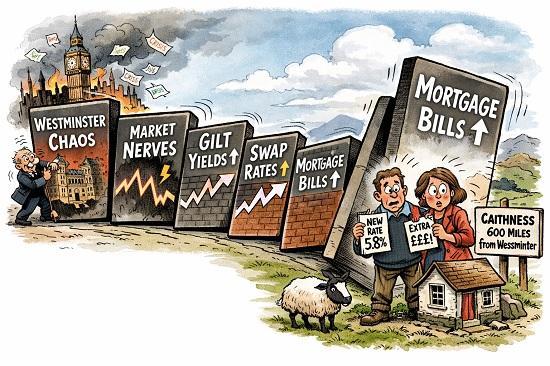
Political drama in London might feel distant from Wick or Thurso, but it has a direct line into your mortgage payments. Every bout of instability in Westminster such as leadership speculation, fiscal uncertainty, election noise sends a ripple through financial markets. By the time that ripple reaches Caithness, it shows up as higher mortgage rates, fewer deals, and rising monthly costs.
Political instability makes investors nervous
When markets sense uncertainty, they demand higher returns to lend to the UK. That pushes up gilt yields — the government’s borrowing costs. Gilt yields are the foundation of mortgage pricing, so when they rise, lenders reprice mortgages upward.
This happens even if the Bank of England keeps the base rate frozen.
Higher gilt yields mean higher mortgage rates
Most UK mortgages are fixed‑rate, and lenders hedge them using financial contracts tied directly to gilt yields. When political instability pushes those yields up, lenders’ costs rise — and they pass that cost straight to borrowers.
That’s why mortgage rates have risen several times this year without a single Bank Rate increase.
Caithness feels the squeeze more sharply
The Far North always pays more for national instability:
Fewer lenders operate locally
Lower incomes make affordability tighter
Higher living costs (fuel, food, heating oil) leave less room for mortgage shocks
Older housing stock means higher running costs
A 0.5% rise in mortgage rates hits a Caithness household harder than one in the Central Belt.
What this means for 2026
Unless political stability returns, Caithness households should expect:
mortgage rates to stay elevated
lenders to keep withdrawing and repricing deals
remortgaging to remain expensive
first‑time buyers to face tougher affordability tests
In short: Westminster turbulence becomes a real‑world financial squeeze in the Far North.