Slim Majorities - Scotland’s Independence Debate After 2026 - See You On The Flip Side
13th May 2026
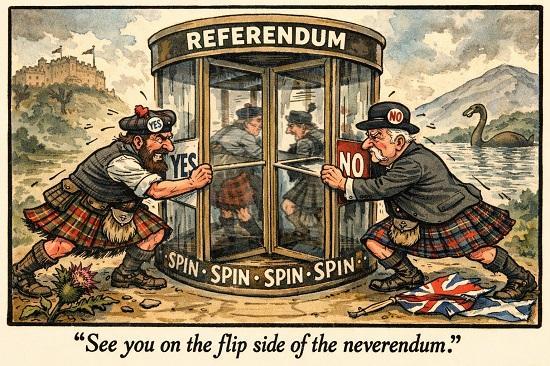
The Scottish parliamentary elections of May 2026 returned the SNP as the largest party, with 58 seats, supported by a record 15 Greens. Together they form a pro‑independence bloc, though still short of an outright majority.
First Minister John Swinney wasted no time in declaring that Scotland must secure independence before Nigel Farage could plausibly become UK Prime Minister, warning of “catastrophic consequences” if Reform UK were to dominate Westminster in 2029. The message was clear that the independence question is not going away, and the parties that support it remain determined to force another referendum.
But what if such a referendum were won by only the slimmest of margins? Far from settling the matter, a razor‑thin Yes would almost certainly provoke No‑voters to demand another vote, using the same democratic arguments in reverse.
Just as independence campaigners have argued that Brexit changed the circumstances of 2014, unionists could argue that a narrow Yes lacked legitimacy and should be revisited. The precedent of Brexit — a 52–48 result that led to years of turmoil — looms large. Scotland could find itself trapped in a cycle of referendums, each side claiming the right to revisit the decision until it secured a decisive majority.
That instability would not remain confined to politics. Financial markets react sharply to uncertainty, and a Scotland that voted Yes by a whisker would face higher borrowing costs. Investors would demand a premium to lend to a state whose constitutional future remained contested.
Government bonds would carry higher yields, swallowing more of the budget in debt interest. Households and businesses would feel the squeeze too, with mortgages and loans priced higher than in the rest of the UK. For Caithness, already burdened by rural premiums, this would be another hidden tax.
The Yes campaign’s promise of re‑joining the EU adds another layer of complexity. Accession requires unanimous consent from all member states, and Spain has long worried about encouraging Catalan separatism. A single veto could block Scotland’s entry, leaving it outside both the UK and EU. In that limbo, trade barriers would rise on two fronts, and borrowing costs would climb further as investors priced in the uncertainty. For Highland communities, the risk is tangible pointing to higher import costs, fragile supply chains, and delayed investment in ferries and infrastructure.
Nor is Europe the only external risk. As a small independent state, Scotland would be more exposed to U.S. tariffs. Scotch whisky, which makes up a quarter of Scotland’s exports to the U.S., has already been targeted once.
Although Donald Trump recently scrapped the 10% tariff following King Charles’s state visit, the episode showed how vulnerable Scotland’s industries are to political gestures in Washington. A future tariff could return just as quickly, and without the bargaining power of the UK, Scotland would struggle to secure exemptions. For Caithness, where whisky jobs and rural supply chains matter, the consequences would be immediate.
The conclusion is sobering. The 2026 elections have kept independence firmly on the agenda, but they have also highlighted the risks of pursuing it without a decisive mandate. A slim Yes would invite calls for another referendum, undermine economic stability, and complicate Scotland’s path to Europe. It would expose the country to higher borrowing costs and external trade shocks. For Caithness, the fragility of rural life would be magnified by constitutional uncertainty.
Independence may promise sovereignty, but without clarity and stability, it risks becoming another hidden tax to b paid in higher prices, weaker services, and endless political wrangling. The Yes voters may see this s small price to pay for more control.
As with the Brexit referendum do people really understand the consequences on either side of the debate with political parties pushing their own partisan views. The general public was poorly served by politicians on all sides in the Brexit referendum with vague promises that thing would improved by leaving the EU without fully understanding how it all worked. Maybe we should have a test to see if voters can pass on questions such as how is this or that actually funded or do you understand the gilt market. Perhaps facetious but with no understanding voters are left to trust the shouting voice from all sides. Do you trust any of them? See you on the flip side..........
For Younger Readers - A definition
The phrase "see you on the flip side" originated from radio DJs in the mid-20th century, referencing the "flip side" (or B-side) of vinyl 45-rpm records. When finishing a popular song on the A-side, DJs would say this to indicate they would play the other side or simply see listeners after the record was turned over.
Musical Origin: Vinyl records (45 rpm singles) had two sides: Side A (the hit) and Side B (the "flip side").
Radio Lingo: DJs frequently used this phrase in the 1950s/60s as a clever, informal way to say "goodbye" or "see you later" when switching to the other side of a record or closing a show.
Adaptation: The phrase became popular as a casual way to say "see you soon" or "see you on the next turn" (like in a conversation or the next day).