SHOULD YOU PAY OR SHOULD DATA?CENTRE GIANTS FOOT THE BILL? Why the UK’s New Electricity Gold Rush Could Leave Ordinary Households Picking Up the Tab
15th May 2026
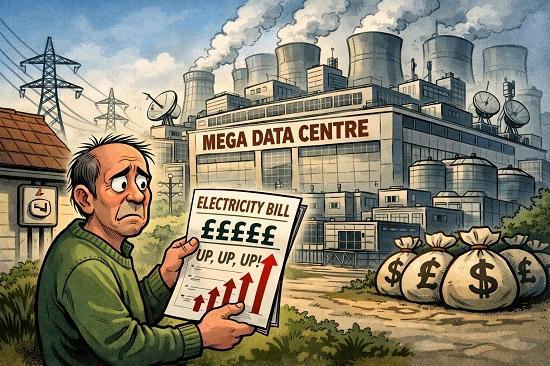
Data centres have quietly become one of the UK’s fastest growing energy consumers. They are vast, windowless fortresses of servers humming day and night, drawing more electricity than many towns and drinking more water than some industries. They power AI, cloud computing, streaming, banking, logistics, and almost every digital service we now depend on. But behind the sleek marketing lies a blunt economic question.
Who pays for the enormous electricity infrastructure these facilities require. You, or the companies building them?
Right now, the answer is uncomfortable: you do.
And unless policy changes, your bills will keep rising as more data centres plug into an already strained grid.
The New Electricity Landlords
Across the UK, data centres already consume 5.8% of all electricity — a share expected to quadruple by 2030 as AI accelerates demand. A single hyperscale facility can draw 100–500 MW, the same as a medium‑sized town. Yet unlike towns, data centres don’t grow organically over decades. They arrive suddenly, demand instant access to high‑voltage power, and require expensive new substations, transformers, and grid reinforcements.
Under current rules, these costs are socialised
That means the bill for a £200 million grid upgrade triggered by a private data centre is spread across:
households
small businesses
shops
farms
public services
In other words: you subsidise them.
This is why electricity bills in places like Caithness — already hammered by transmission charges — risk rising further even though no data centre is being built locally.
Why More Data Centres Mean Higher Bills
Three forces push prices upward:
Demand rises faster than supply
When data centres increase national demand, the grid relies more on expensive gas‑fired generation. Gas sets the marginal price — so everyone pays more.
Grid congestion forces costly upgrades
The South East is already at breaking point. Reinforcements cost billions, and under current rules, those costs are spread across all users.
Balancing the system becomes more expensive
Data centres run 24/7. They don’t turn off when the wind drops. That forces National Grid to buy more balancing services — again, costs passed to consumers.
The result is predictable higher bills for households and businesses, even in regions that see no benefit.
The Water Problem
Data centres also consume vast quantities of water for cooling — sometimes millions of litres per day. This doesn’t directly raise electricity prices, but it increases pressure on local water systems and adds to the environmental footprint of an industry that markets itself as “clean”.
The Fairness Question
Should a global tech giant running AI servers in Slough or London be subsidised by a pensioner in Wick?
Should a small Highland business pay higher network charges so Amazon or Google can expand cloud capacity?
This is the political and economic tension now emerging across the UK.
A Policy Model That Fixes the Problem
A simple principle:
“If you trigger the cost, you pay the cost.”
Here’s how a fair system would work.
Create a new category: Strategic Large Demand Users (SLDUs)
This applies to ultra‑high‑demand facilities:
≥50 MW demand
24/7 operation
high load factor
This captures hyperscale data centres, not ordinary businesses.
Make SLDUs pay the full cost of grid reinforcements
If a data centre requires:
a new 400kV line
a new substation
transformer upgrades
local reinforcement
They pay 100% of the cost, not the public.
Payments could be:
upfront
milestone‑based
long‑term infrastructure charges
But never socialised.
Introduce locational pricing
If a company insists on building in a congested area like West London, they pay more.
If they build near renewable generation or surplus capacity, they pay less.
This encourages sensible siting and reduces national costs.
Require system benefits in exchange for any discounts
To qualify for reduced charges, data centres must:
co‑locate with renewables
provide demand‑response capability
offer backup generation to the grid
supply waste heat to local communities
This turns them from grid burdens into grid assets.
Protect consumers with a “no detriment” rule
Ofgem should enforce a simple test:
“Would this project raise bills for existing consumers?”
If yes, the project must pay more or be refused.
What This Means for Ordinary People
Under this model:
Your bills stop rising because of private data centres
Grid upgrades are funded by the companies that need them
The UK avoids a capacity crunch
Data centres are pushed to build where the grid can cope
Rural and northern regions stop subsidising the South East
It restores fairness to a system that has drifted far from it.
Right now, you’re paying for the digital gold rush.
Under a fair policy, the companies making billions from it would pay instead.