ARE CONSULTATIONS JUST A WAY OF KICKING DECISIONS DOWN THE ROAD?
15th May 2026
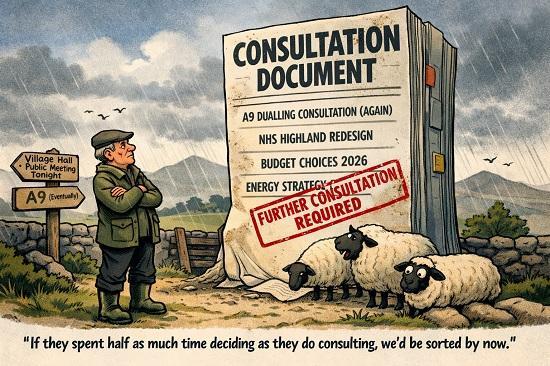
Why the Highlands is Drowning in Surveys While Nothing Actually Happens.
There’s a particular kind of fatigue spreading across the Highlands not the kind caused by long drives to Raigmore or the weekly battle with potholes, but something quieter, more bureaucratic, and somehow even more exhausting. Consultation fatigue. How did the country get things done in the past without consultations?
That slow, creeping realisation that every “Have Your Say” exercise ends the same way: a glossy report, a polite thank‑you, and then… nothing.
And the question many Highlanders are now asking sometimes out loud, sometimes through gritted teeth is simple:
Are consultations just a way of avoiding decisions altogether?
The Highlands: Consultation Capital of Scotland
In the last few years alone, Highland communities have been asked to respond to:
The Highland Council budget consultation — a yearly ritual where residents are invited to choose which limb to amputate from already‑hollowed‑out services.
NHS Highland redesign consultations — endless “engagement exercises” about service changes that feel pre‑decided long before the first public meeting. And in Caithness maternity services or the almost forgotten consultations on health hubs in Thurso and Wick
Transport Scotland’s A9 and A96 consultations — years of surveys, exhibitions, and “route option assessments” while the dualling timetable drifts further into the mist.
Scottish Government energy and planning consultations — from grid upgrades to onshore wind policy, each one promising “community voices at the heart of decision‑making” while the real decisions happen elsewhere.
Every one of these exercises comes wrapped in the same language: empowerment, engagement, partnership, co‑design.
But the lived experience in Caithness, Sutherland, and across the Highlands is very different.
The Pattern Everyone Recognises
It goes like this:
A problem emerges — a service is failing, a road is unsafe, a hospital is short‑staffed.
Officials announce a consultation — often with tight deadlines and documents thicker than a winter electricity bill.
Communities respond in good faith — public meetings, local campaigns, detailed submissions.
A report is published — summarising what people said, usually in neutral, bloodless language.
The decision is delayed “further analysis required”, “options under review”, “next phase to follow”.
Nothing changes or worse, the original plan proceeds anyway.
It’s no wonder people are asking whether consultations are now a political tool for deferring responsibility, rather than a democratic tool for shaping decisions.
The Highland Twist: Distance Makes It Worse
In the Highlands, consultation fatigue hits harder because:
Services are already stretched
Travel distances make participation difficult
Digital connectivity is patchy
Decisions are made far from the communities affected
When a consultation asks a Caithness resident to comment on a service based in Inverness or Edinburgh, it’s hard not to feel like the process is designed for convenience — but not yours.
The Psychology of Delay
Consultations can be useful. They can surface local knowledge, test ideas, and expose flaws.
But they can also be used to:
Diffuse anger without fixing the issue
Buy time when budgets are tight
Create the appearance of action
Shift responsibility onto the public (“We consulted — you didn’t object strongly enough”)
In other words, consultations can become a political safety blanket.
The Hard Question
So here’s the uncomfortable truth many Highlanders now recognise:
If a government or agency launches a consultation every time a decision is needed, is it really listening — or simply avoiding the decision?
When consultations become a substitute for action, they stop being democratic and start being performative.
What Would Genuine Consultation Look Like?
A real, meaningful consultation would:
present clear options, not vague “themes”
show what is genuinely up for debate
publish how public input changed the final decision
commit to a timeline that doesn’t drift for years
avoid repeating the same consultation every 18 months
Most importantly, it would lead to an actual decision — not another round of “engagement”.
The Friday Rant Conclusion
Highlanders are patient people. They’ve lived through centralisation, shrinking services, and decades of being told “we’re reviewing the situation”. But patience is not the same as acceptance.
Consultations should be a bridge between communities and decision‑makers.
Too often, they feel like a holding pen — a place where difficult choices are parked until the political weather improves.
And until that changes, the question will keep echoing across the Highlands:
Are consultations a tool for democracy — or just a way of kicking decisions further down the road?