China Builds the Solar Panels, the West Builds the Committees: What the Global Net?Zero Race Really Looks Like
16th May 2026
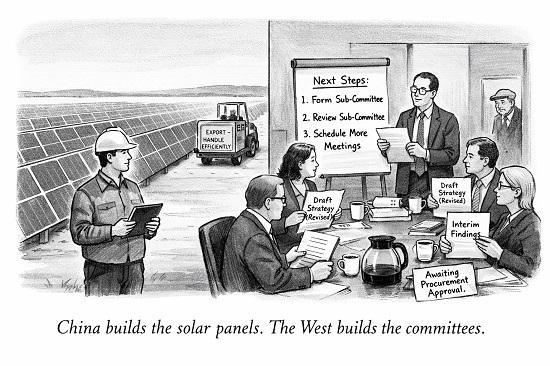
For years, Western governments have spoken confidently about “leading the world” on climate action. But if you follow the money, the manufacturing, and the megawatts, a different picture emerges. It is one where China is sprinting ahead with industrial‑scale investment while the West is still rearranging the chairs in the consultation room.
China’s official target is clear: peak emissions before 2030 and reach net‑zero by 2060. Critics say 2060 is too late, but the pace of change inside China is staggering. In 2023 alone, China installed more solar capacity than the entire world did in 2022. It now produces over 90% of global solar modules, dominates battery manufacturing, and is building wind turbines at a rate that makes European output look like a cottage industry.
Meanwhile, Western nations including the UK talk about “green industrial strategies” while simultaneously outsourcing the hardware of the energy transition to China. The result is a strange dependency where the West wants to decarbonise, but it relies on Chinese factories to do it.
This is not just an economic story; it’s a geopolitical one. China’s dominance in clean‑tech manufacturing gives it leverage in global supply chains. Western governments respond with subsidies, taskforces, and “roadmaps”, but the gap remains wide. The US Inflation Reduction Act has begun to shift the balance, but Europe and the UK remain bogged down in process, paperwork, and political hesitation.
For places like Caithness, the contrast is particularly sharp. We sit in one of the windiest regions in Europe, yet turbine components still arrive from China. We have the coastline, the grid potential, and the engineering heritage — but not the manufacturing base. The Highlands could be a powerhouse of green industry, yet we remain consumers rather than producers of the transition.
China’s approach is brutally simple: build, scale, repeat. The West’s approach is more delicate: consult, review, revise, consult again, and eventually announce a pilot project. The result is that China is shaping the global energy future, while Western nations are shaping the minutes of the next meeting.
None of this means China is perfect. It still burns more coal than any other country, and its energy system is a contradictory mix of world‑leading renewables and old‑school fossil expansion. But the direction of travel is unmistakable: China is building the infrastructure of the next energy era, while the West is still debating how to define “infrastructure”.
If the UK wants to keep up — or even stay relevant — it needs to move from strategy to steel, from consultation to construction, and from aspiration to actual output. Otherwise, we will continue importing the tools of our own energy transition from the very country we claim to be competing with.
China builds the solar panels. The West builds the committees. And the climate clock keeps ticking.