When Drilling Slows, Scotland Feels It: What North East Rig Out’s Collapse Tells Us About the Energy Downturn
18th May 2026
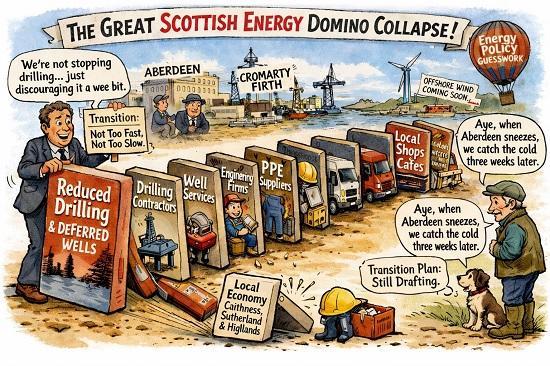
North East Rig Out (NERO), a long‑established Aberdeen workwear and PPE supplier, has gone into liquidation after more than four decades in business. Eight jobs have been lost, and the liquidators were blunt about the cause: a prolonged downturn in the energy market and a sharp reduction in orders from oil and gas clients.
For many in the North‑east, this is not just another insolvency notice. It is a warning flare for Scotland’s wider energy‑dependent economy — from Aberdeen’s industrial estates to the fabrication yards of the Cromarty Firth and the engineering workshops of Caithness.
And behind the commercial pain sits a political question:
Is government reluctance to support new drilling accelerating the downturn and discouraging investment?
We explore the supply‑chain impact, the regional consequences, and the policy tensions shaping Scotland’s energy future.
The First to Fall: Who Gets Hit When Drilling Reduces?
When operators scale back drilling, the pain does not start with the oil majors. It begins with the outer rings of the supply chain — the firms that rely on steady operational activity rather than big-ticket projects.
Tier‑3 and Tier‑4 suppliers — the most exposed
These companies are furthest from the wellhead but most dependent on day‑to‑day offshore activity:
Workwear and PPE suppliers
Uniform branding and embroidery firms
Small fabrication workshops
Transport, haulage and courier services
**Catering and facilities contractors
NERO sat squarely in this category. When offshore rotations fall, PPE orders collapse. When engineering firms lose contracts, uniform orders vanish. These businesses operate on thin margins; a sustained downturn is fatal.
Tier‑2 engineering and technical services
These firms feel the slowdown next:
Rope access
Valve servicing
NDT and inspection
Electrical and mechanical maintenance
Subsea tooling support
When wells are deferred, these companies lose both routine and project work.
Tier‑1 drilling and well‑services companies
Even the big players feel it:
Drilling contractors
Mud‑logging and well‑testing teams
Subsea intervention specialists
A reduction in drilling means fewer contracts, fewer rotations, and fewer vessels mobilised.
Why This Matters for Scotland’s Economy
Aberdeen: The epicentre of the shock
Aberdeen’s economy is still heavily concentrated in oil and gas. When drilling slows:
Industrial estates lose tenants
Skilled workers leave the region
Retail and hospitality suffer from reduced contractor spending
Commercial property vacancies rise
Local supply chains shrink and hollow out
NERO’s collapse is one example of a much wider pattern.
The Highlands: Smaller economies, bigger proportional impacts
Places like Caithness, Sutherland and Easter Ross are not as dependent on oil and gas as Aberdeen — but they are deeply connected to it:
Offshore workers from Wick, Thurso and Lybster rotate through Aberdeen
Engineering firms in Invergordon, Wick and Thurso supply components and labour
Haulage firms move equipment to and from the Cromarty Firth
Reduced offshore income hits local shops, garages and services
In smaller communities, one lost contract can ripple through the entire local economy.
Is Government Reluctance to Support New Drilling Accelerating the Downturn?
This is where economics meets politics.
Industry view: policy uncertainty is killing investment
Many operators and supply‑chain businesses argue that:
The Energy Profits Levy (windfall tax) reduces investment appetite
Delays or reluctance to approve new North Sea licences create uncertainty
Political messaging around “no new oil and gas” discourages long‑term planning
Investors are shifting capital to jurisdictions with clearer signals
From their perspective, Scotland and the UK risk a managed decline turning into unmanaged collapse.
Government view: transition must accelerate
The Scottish Government has emphasised:
A shift toward renewables, hydrogen and CCS
The need to reduce reliance on fossil fuels
The importance of climate commitments
Support for a “just transition” rather than indefinite drilling
But critics argue that transition industries are not yet large enough to absorb the workforce or replace the economic activity lost from oil and gas.
The result: a policy gap
Scotland is caught between:
An energy sector that still provides tens of thousands of jobs
A transition sector that is growing, but not fast enough
A political environment where drilling approvals are contentious
A supply chain that cannot survive long pauses in activity
This gap is where companies like NERO fall.
What Happens Next?
If drilling continues to decline without replacement industries:
More supply‑chain insolvencies
Loss of specialist skills Scotland will need for offshore wind and CCS
Reduced tax revenues
Shrinking local economies in Aberdeen and the Highlands
Increased pressure on transition funds and retraining programmes
If policy becomes clearer and investment stabilises:
Drilling may not return to past levels, but
Predictable activity could sustain the supply chain
Offshore wind, hydrogen and CCS could absorb skills
Ports like Cromarty Firth and Scrabster could benefit from new workstreams
The key is clarity — something the sector argues has been lacking.
NERO’s Collapse Is a Symptom, Not the Cause
North East Rig Out did not fail because it was poorly run. It failed because the ecosystem it depended on is shrinking, and because the transition away from oil and gas is happening faster in politics than in the real economy.
For Aberdeen, Caithness and the wider Highlands, the message is clear:
If Scotland wants a just transition, it must manage the decline — not simply watch it happen.