The Green Dividend: How the Net-Zero Economy Became the UKs Secret Growth Engine
27th May 2026
The UK economy may be struggling for momentum, but a quiet revolution is taking place within its industrial heartlands. As traditional markets face shifting headwinds, the transition to alternative energy has emerged as an aggressive driver of domestic employment.
Data compiled by CBI Economics and the Energy & Climate Intelligence Unit (ECIU) reveals that the UK’s net-zero sector now supports 951,000 full-time equivalent jobs. Accounting for roughly 2.9% of total UK employment, the green economy expanded by more than 10% over a 12-month period, expanding roughly three times faster than the wider economy.
For professionals, engineers, and tradespeople, the shift represents a structural realignment of where economic value—and premium compensation—is being concentrated.
The Premium on Green Labour
The rapid expansion of clean energy has triggered a localized labour shortage, driving up compensation for specialized skills. Jobs tied directly to net-zero businesses are heavily productive, generating roughly 40% more economic output per worker than the national benchmark.
This high productivity directly correlates with higher wages.
The Green Premium: The average salary in the net-zero sector stands at £43,100.The Economic Contrast: This figure is 15% higher than the UK national average of £37,430.The Ripple Effect: Beyond the 273,000 people employed directly by green firms, the sector sustains an additional 679,000 jobs down the domestic supply chain.
Average UK Salary vs. Net-Zero Economy Salary
National Average: £37,430
Net-Zero Sector: £43,100 (+15%)
A Regional Realignment
Crucially for the UK’s long-term regional development, the growth of the alternative energy workforce is heavily decentralized away from London. Instead, investment is flowing into coastal regions, manufacturing hubs, and industrial clusters.
Scotland
Scotland emerged as a primary beneficiary of offshore wind and marine infrastructure investments. The region experienced a 21.3% surge in green employment since 2022, pushing its local net-zero workforce past the 100,000 threshold.
English Industrial Hubs
Heavy recruitment and infrastructure deployment are concentrating job opportunities across the West Midlands, Yorkshire and the Humber, and the South West.
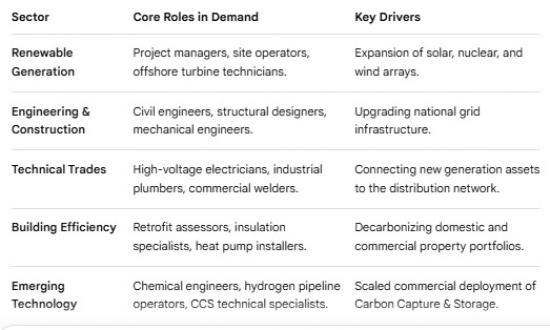
Mapping the In-Demand Roles
The labour market’s appetite spans both highly technical white-collar positions and advanced blue-collar trades. According to the CBI framework, recruitment demand is concentrated across five primary pillars:
The Macro Picture
The structural shift toward alternative energy is underpinned by capital velocity. The sector has drawn over £23 billion in private investment since 2019, turning sustainability into a defensive, high-yield asset class for corporations.
As energy security remains a critical macroeconomic priority, the green workforce is no longer a niche offshoot of corporate social responsibility. It has matured into a foundational pillar of the UK's industrial base, offering clear career longevity, insulation from traditional market volatility, and a measurable wage premium for the next generation of British workers.
Up-skilling the Workforce and the Employers Leading the Charge
The macroeconomic growth of the UK’s £37-billion net-zero economy is creating a critical challenge: a massive green skills shortage.
For traditional tradespeople—including electricians, plumbers, and heating engineers—this supply-demand mismatch presents a significant up-skilling opportunity. Transitioning into renewable energy installation unlocks higher income brackets and insulates careers against long-term fossil fuel declines.
To capitalize on this shift, tradespeople are utilizing localized training pipelines to secure roles with major green developers expanding across regional hubs.
Funded Training Pathways for Tradespeople
Up-skilling does not require a multi-year university degree. Short-form, subsidized vocational qualifications are designed to get experienced tradespeople certified quickly.
Skills Bootcamps: Part of the UK Government's Skills for Life initiative, these are flexible, fully funded courses lasting up to 16 weeks. Providers like Trade Skills 4U offer green skills bootcamps targeting advanced electrical installations, EV charging infrastructure, and smart grid connectivity.
Heat Pump and Solar Certifications
Experienced heating engineers and plumbers are transitioning via fast-track certifications. National networks like Logic4training deliver Level 2 and Level 3 low-carbon HVAC awards, certifying installers for heat pump integration and solar thermal systems.
Regional College Traineeships
Local further education networks—particularly in industrial hubs—are rolling out blended, employer-backed technical pathways. For instance, programs via Groundwork London provide fully funded 5-week retrofit installation bootcamps combining classroom work with direct site experience.
Top Corporate Employers Hiring in Regional Hubs
Private capital velocity is concentrated in specific corporate giants driving massive hiring campaigns across the UK's regional net-zero hotspots.
Scotland (Offshore Wind & Marine Infrastructure)
Ørsted
A global leader in offshore wind, recruiting heavily for turbine technicians, offshore high-voltage operators, and marine logistics managers.
EDF Renewables
Actively hiring engineers and site operators for utility-scale wind farms and regional battery storage arrays across Scotland.
West Midlands & South West (EV Infrastructure & Solar)
Liberty Global (egg Group)
Deploying massive capital into the electrification of road transport and business power. They routinely hire technical managers, commercial electricians, and high-voltage specialists to install BESS (Battery Energy Storage Systems) and widespread solar PV infrastructure.
OVO Energy
Headquartered in the South West, OVO is hiring domestic smart-meter installers, heat pump technicians, and EV home-charging specialists.
Yorkshire, the Humber & National Grid Hubs
Octopus Energy
Expanding its generation arm rapidly, recruiting heavily for field heat-pump engineers, solar installers, and technical asset managers.
Siemens Gamesa
Dominating the Humber region via massive blade manufacturing facilities and turbine operations, hiring mechanical engineers, industrial welders, and production technicians.
Finding the Right Entry Point
For tradespeople looking to make the leap, the quickest route to employment involves targeting niche renewable recruitment agencies. Specialist consultants such as The Green Recruitment Company and Taylor Hopkinson actively match newly certified tradespeople and technical managers with contractors working directly for major developers like Ørsted and Liberty Global.