Wick Town Centre Improvements - The Edinburgh Trams Project (Pocket?Sized Edition)
28th May 2026
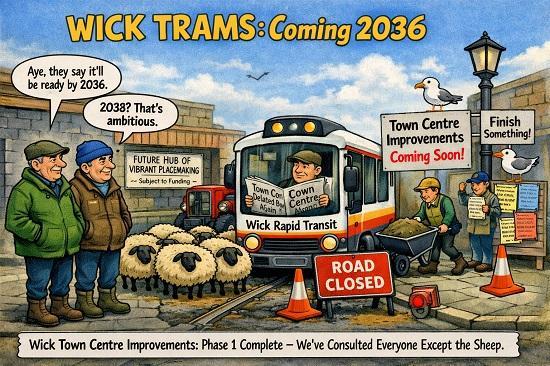
Wick has waited a long time for its town‑centre improvements — long enough for weeds to develop tenancy rights and for shopfronts to start leaning on each other for emotional support. But now, with the latest announcement of delays, the whole thing is beginning to look suspiciously like a miniature, Highland‑issue version of the Edinburgh Trams fiasco.
Not in scale, of course. Edinburgh spent a billion pounds to build a tram that takes longer than walking. Wick, by contrast, is struggling to deliver a few pavements, some lighting, and a bit of civic dignity. But the pattern is unmistakable.
Step 1: Announce a Grand Vision
Show the public glossy drawings of a Wick so vibrant it could almost pass for a town that hasn’t been systematically ignored for 40 years.
Promise “transformational change”.
Use phrases like placemaking, active travel, and gateway experience.
Everyone nods politely, because we’ve heard this script before.
Step 2: Consult Until the Heat Death of the Universe
Hold consultations.
Then hold consultations about the consultations.
Then revise the plans based on feedback from the consultations about the consultations.
Then announce that further engagement is required because the last consultation didn’t fully capture the views of the people who didn’t attend the first consultation.
Meanwhile, Bridge Street continues its slow metamorphosis into a post‑apocalyptic film set.
Step 3: Discover That Money Is Finite
This is the Highland Council twist.
Edinburgh blew its budget.
Wick, on the other hand, never had enough budget to blow in the first place.
Cue the classic Highland regeneration loop:
Draw ambitious plans
Realise the money won’t cover them
Redesign
Costs rise
Redesign again
Repeat until morale collapses
It’s like watching someone try to renovate a house using only coupons and optimism.
Step 4: Delay, Drift, and Denial
The worst part isn’t the delay — it’s the silence.
Nothing kills public confidence faster than nothing happening.
No diggers.
No scaffolding.
No visible progress.
Just the slow, steady decay of a town centre that desperately needed action five years ago.
At this point, Wick residents would settle for a single bollard being installed, just to prove the project still exists.
Step 5: The Public Loses Patience
This is where the Edinburgh Trams comparison really lands.
People start making jokes.
Then the jokes become metaphors.
Then the metaphors become the public narrative.
Wick is now at the “sarcastic resignation” stage — the point where locals say things like:
“Aye, it’ll be ready by 2036.”
“Maybe they’re waiting for the buildings to fall down so they don’t need to fix them.”
“At this rate, the trams will reach Wick before the town centre is finished.”
When humour becomes the coping mechanism, the project has officially entered the Trams Zone.
Why This Actually Matters
Edinburgh could afford a decade‑long farce.
Wick can’t.
Every year of delay means:
more empty units
more dereliction
more footfall drifting to Inverness
more services centralised away
more young people leaving
A stalled regeneration project here isn’t an embarrassment — it’s a missed lifeline.
Wick doesn’t need a billion‑pound tram disaster.
It just needs pavements that don’t try to kill you, lighting that works, and a town centre that looks like someone cares.
But right now, the whole thing is starting to feel like a Highland‑scale remake of the Edinburgh Trams saga — same plot, smaller budget, colder weather.
If the Council wants to avoid becoming the punchline of its own regeneration story, it needs to stop consulting, stop revising, and get it done.