Blown Away: How Scotland’s Wind Wealth Slipped Through Its Fingers
28th May 2026
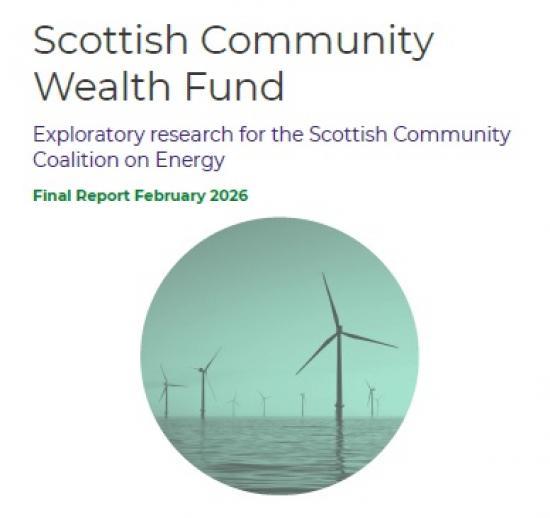
When the wind howls across the Flow Country, it’s easy to believe Scotland has cracked the energy puzzle. Turbines spin, lights stay on, and politicians talk about “green prosperity.” But the latest research from the Centre for Local Economies (CLE) — funded by Uplift, Community Land Scotland, and Community Energy Scotland — tells a very different story.
It’s called “Blown Away: Following the Money in Scotland’s Onshore Wind Sector”, and its findings are as bracing as a Wick gale.
The headline: billions blowing south
Over the past five years, Scotland’s onshore wind developers have made £5.6 billion in profits.
Scottish communities, meanwhile, received just £147 million in community‑benefit payments — roughly 2.6 % of the total.
That’s not a rounding error; it’s a structural failure.
The report calls it a “gross policy failure” — twenty years of missed opportunity to embed community wealth in the renewable transition.
The illusion of generosity
The Scottish Government recommends a voluntary community‑benefit rate of £5,000 per MW per year.
Voluntary is the key word.
Many developers pay less. Some pay nothing. Others offer short‑term grants dressed up as long‑term partnerships.
The result? A patchwork of goodwill instead of a system of justice.
In Caithness, where turbines dominate the horizon, the imbalance is stark. The landscape generates power for the grid and profit for shareholders but the local dividend barely covers a few community projects and heating grants.
Ownership: the missing piece
Only 1 % of Scotland’s onshore wind farms are community‑owned.
In Denmark, it’s 50 %.
That single statistic explains almost everything.
When ownership is local, profits stay local.
When ownership is corporate, profits leave — quietly, efficiently, and permanently.
The CLE report argues that Scotland’s renewable boom has been built on a model of extraction, not participation.
Communities host the infrastructure but don’t share the income.
It’s the same old story, just with greener branding.
The next wave: double the turbines, double the inequality?
Scotland plans to double its onshore wind capacity from 10 GW to 20 GW by 2030.
Without reform, the report warns, the next decade will simply magnify the existing inequality.
More turbines.
More profits.
Same imbalance.
The authors propose a Scottish Community Wealth Fund — a national mechanism to capture a fair share of renewable profits, potentially worth £500 million per year by 2035.
That money could fund local energy schemes, retrofit homes, and rebuild rural economies.
But only if the political will exists to make it happen.
Caithness: the case study nobody’s writing
For Caithness, the report reads like a mirror.
We host the infrastructure, endure the visual impact, and watch the profits vanish south.
Community benefit funds help but they’re crumbs from a table set elsewhere.
The real wealth, the steady income, the long‑term stability, all flow out of the region.
Imagine if even a fraction of those profits stayed here:
local energy cooperatives
affordable heating schemes
investment in transport and digital infrastructure
apprenticeships tied to turbine maintenance and green engineering
Instead, we get the occasional grant cheque and a press release about “partnership working.”
The moral of the wind
The CLE report doesn’t attack renewables — it attacks the way we’ve done them.
It argues for a model that treats communities not as hosts but as shareholders.
That’s not radical; it’s common sense.
If the wind belongs to everyone, so should the wealth it creates.
The Highland perspective
In the Highlands, this debate isn’t abstract.
It’s about survival.
Energy costs are crippling households even as turbines turn overhead.
Fuel poverty and energy abundance coexist within sight of each other.
The report’s message to policymakers is simple:
stop exporting the profits of the Highlands while importing its power.
Time to change the weather
The Centre for Local Economies has done what government should have done years ago — followed the money.
And the trail leads straight to London, Luxembourg, and corporate headquarters far from the glens that generate the power.
If Scotland wants a truly just transition, it must make community ownership the rule, not the exception.
Otherwise, the next decade of wind expansion will be just another chapter in the long story of rural extraction. A story Caithness knows too well.
Read the full report HERE
Pdf 40 Pages
Read a 3 Page Summary HERE