What Would Actually Happen If Millions Switched Everything Off for 24 Hours? on 1 July New Cap Day
28th May 2026
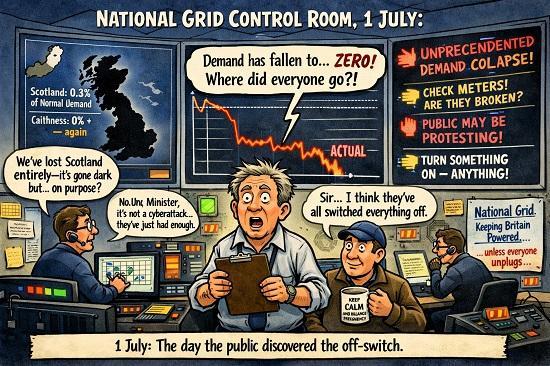
What would happen if energy consumers mostly switch off on one day say 1 July when the new energy cap increase comes in. It would be silent protest that would be very visible to politicians and energy provider profits sink for a day.
The grid would stay on but operators would panic
The National Grid ESO manages supply and demand minute‑by‑minute.
A sudden, massive drop in demand is just as disruptive as a surge.
If millions switched off Demand would fall far below forecast and Gas turbines would be ramped down.
Wind output would be curtailed
Interconnectors would be throttled
Control rooms would scramble to stabilise frequency
Technically manageable — but deeply unusual.
Grid engineers expect spikes, not a national “lights‑off protest”.
Wholesale electricity prices would crash for the day as Electricity is traded in half‑hour blocks.
If demand collapsed:
Day‑ahead prices could fall to near zero
In some blocks, prices could even go negative
(meaning generators pay to stay online)
This has happened before during storms or lockdowns — but never due to coordinated consumer action.
Suppliers would lose money.
Generators would lose money.
Traders would lose money.
The public would lose nothing — except maybe a day of hot meals.
Suppliers would face a PR nightmare
On the very day the new energy cap begins, a mass switch‑off would send a message:
“We reject your prices.”
Suppliers would be forced to respond publicly.
Some might accuse consumers of “destabilising the system”.
Others would quietly panic about reduced revenue.
A 24‑hour boycott wouldn’t bankrupt anyone — but it would rattle the industry.
Politicians would absolutely notice
A national drop in demand of even 5–10% would show up instantly in ESO data.
A drop of 20–30% would be impossible to ignore.
Government would face questions like:
Why are people protesting the energy cap?
Why are households so angry?
Why is the system so fragile?
It would become a headline political story within hours.
It would expose the uncomfortable truth about UK energy. A mass switch‑off would highlight:
how dependent the system is on predictable consumer behaviour
how little control households normally have
how sensitive the market is to demand shocks
how fragile the “just trust the system” narrative really is
It would also show that consumers do have power — just not the kind the industry likes.
It would NOT[/]b
damage the grid
cause blackouts
break appliances
endanger hospitals (they have exemptions and backup)
cause a national emergency
The grid is built to handle sudden changes just not ones caused by millions of angry households.
[b]Highland & Caithness Angle
In Caithness, where energy prices bite harder and incomes stretch thinner, a 24‑hour switch‑off would be:
easy for many households (we’re used to coping)
symbolically powerful
a reminder that rural Scotland pays more for less
It would also highlight the absurdity that Caithness exports vast renewable power yet still suffers high bills.
A national protest would amplify that contradiction.
The real impact: psychological, not electrical
The grid would survive.
The market would wobble.
But the political shockwave would be the real story.
A coordinated consumer action of that scale would be the biggest energy protest in UK history without a single march, banner, or placard.
Just silence.
And darkness.
For one day.
There have indeed been online discussions and grassroots suggestions about coordinated “switch‑off” protests though none have been formally organised or endorsed by major groups.
Common “Switch‑Off” Ideas
24‑hour blackout protest — people propose turning off all non‑essential electricity for one day to highlight energy‑price injustice.
Timed evening switch‑off — households unplug for one hour at peak time (often 8 p.m.) to create a visible dip in demand data.
Rolling regional switch‑offs — communities coordinate staggered blackouts to show how local action can ripple through the grid.
Symbolic unplug day — promoted as a peaceful, non‑disruptive awareness event rather than a protest, encouraging reflection on energy dependence.
Most of these ideas come from consumer frustration rather than organised activism.
They’re framed as:
a signal of solidarity against rising bills,
a demonstration of consumer power, and
a reminder that households can influence demand.
None advocate damaging infrastructure or unsafe behaviour — the emphasis is on temporary, voluntary disconnection.
Energy analysts warn that:
the grid can handle short drops, but large coordinated ones could confuse forecasting systems;
suppliers might dismiss the gesture as symbolic;
and some fear it could affect vulnerable users if misinterpreted as a call for total blackout.
Supporters counter that even a small visible dip in demand charts would prove public awareness and unity.
In Scotland especially the Highlands the idea resonates because communities already feel disconnected from the profits of renewables.
A Caithness‑style “lights‑off” day would be seen less as rebellion and more as a Highland statement of independence and resilience.