Britain's Growing NEET Crisis: A Warning About the Future of a Generation
30th May 2026
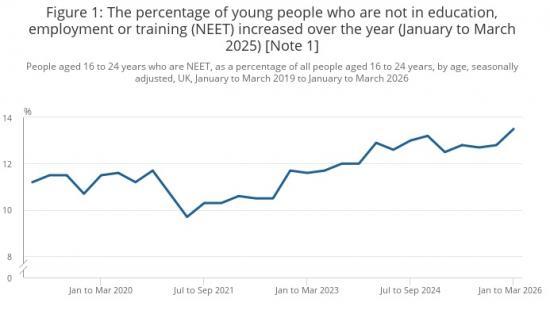
The latest figures from the Office for National Statistics reveal a problem that extends far beyond unemployment statistics. They point instead to a deeper economic and social challenge that has been developing across Britain for many years.
More than one million young people aged between 16 and 24 are now classified as being not in education, employment or training. Behind that figure lies a growing concern about opportunity, economic policy, social mobility and the future direction of the country itself.
According to the ONS, around 1,012,000 young people were classified as NEET during the first quarter of 2026, representing 13.5 percent of all young people in that age group. The figure has risen substantially compared with a year earlier and continues an upward trend that has become increasingly difficult for policymakers to ignore.
The rise is particularly notable among young men, although increases are visible across both sexes. The statistics indicate that Britain is now facing one of its most serious youth disengagement problems in decades.
What makes the figures especially concerning is that they cannot simply be explained as a temporary downturn in the labour market. The data suggests a more structural problem. While around 400,000 young people classified as NEET are unemployed and actively seeking work, the majority are economically inactive. In other words, many are no longer actively participating in either employment or education. This distinction is important because it suggests that the issue is not merely a shortage of jobs but a broader breakdown in pathways into adult working life.
The growth in economic inactivity among younger people has become one of the most striking developments in the modern British labour market. Increasing numbers of young people report health-related barriers, including mental health challenges, while others appear to have become detached from employment opportunities altogether. Government reviews published alongside the debate have highlighted the growing role of work-limiting health conditions, social disadvantage and educational inequalities in driving the problem.
The figures also challenge a popular narrative that young people simply lack motivation or work ethic. Evidence increasingly suggests that many young people face structural barriers that previous generations encountered to a lesser degree. Housing costs have risen dramatically, secure entry-level employment has become harder to obtain and many employers increasingly demand previous experience even for junior roles. At the same time, technological changes and new recruitment systems have altered how young people access the labour market.
The education system itself is also facing growing scrutiny. Britain has traditionally placed heavy emphasis on academic qualifications while vocational pathways have often received lower status. By comparison, countries such as the Netherlands and Germany have developed stronger apprenticeship and technical training systems that create clearer routes from education into employment. International comparisons now show Britain performing increasingly poorly in relation to youth labour market participation, despite spending decades discussing skills shortages and workforce development.
Regional inequality remains another major factor. Opportunities available to young people vary enormously depending upon where they live. In some parts of southern England, access to employment, transport and education remains relatively strong. In other regions, particularly former industrial areas and some rural communities, young people often face far more limited choices. Economic growth has become increasingly concentrated in particular parts of the country, leaving many areas struggling to create sufficient opportunities for younger generations.
The economic consequences of this trend are potentially profound. A generation that enters adulthood disconnected from employment or training may face lower lifetime earnings, weaker career progression and reduced financial security. Pension experts have already warned that delayed entry into the workforce could create significant long-term financial disadvantages due to lost years of earnings, savings and investment growth. What appears today as a youth employment issue could therefore evolve into a future retirement and public finance challenge.
The wider implications extend beyond economics. Employment has traditionally provided not only income but also social connection, confidence, routine and a sense of purpose. When large numbers of young people struggle to establish themselves within education or work, the effects can ripple through communities, affecting social cohesion, wellbeing and long-term life outcomes.
Perhaps the most important lesson from the latest figures is that the problem cannot be solved simply by urging young people to work harder or become more resilient. The scale of the increase suggests that broader economic and policy factors are at play. Britain's productivity growth has remained weak for many years. Housing has become increasingly unaffordable. Infrastructure investment has often lagged behind competitors. Vocational education remains fragmented. Meanwhile, periods of higher interest rates designed to control inflation can reduce hiring and make it harder for younger workers to enter the labour market.
This does not mean inflation control is unimportant. High inflation can be highly damaging, particularly for younger households. However, critics argue that policymakers have focused heavily on managing demand while paying insufficient attention to expanding economic capacity. In effect, governments and central banks have often attempted to manage inflation through slower growth rather than by increasing the economy's ability to produce, build and invest.
The latest ONS figures therefore raise uncomfortable questions not only about young people but about the broader direction of British economic policy. If over one million young adults are outside employment, education or training, it becomes increasingly difficult to argue that the issue lies solely with individual choices. Instead, the statistics point toward deeper structural weaknesses that have accumulated over many years.
The challenge facing Britain is not simply how to reduce the NEET rate. It is how to rebuild pathways into adulthood that offer realistic opportunities for work, housing, skills development and long-term economic security. Without that wider effort, the country risks creating a generation that feels increasingly disconnected from the prosperity and opportunities that previous generations often took for granted.
The ONS figures should therefore be viewed not merely as labour market data but as a warning signal. They suggest that the problems facing many young people are becoming embedded rather than temporary. If left unaddressed, the consequences may be felt not only by today's young adults but by the wider economy and society for decades to come.
The ONS bulletin itself is mainly statistical, but the wider debate around the figures has become much larger because government-commissioned reviews and economists are increasingly warning that Britain may be developing a long-term youth disengagement problem rather than experiencing a temporary employment downturn.
Read the full ONS report HERE