UK and the Netherlands - A Very Different Way To Deal With The NEET Young People
31st May 2026
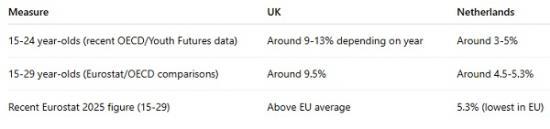
The contrast between the UK and the Netherlands has become one of the most discussed issues in youth employment policy because both are wealthy northern European economies, yet their outcomes for young people are dramatically different.
Recent UK figures show that the number of 16-24 year-olds who are not in education, employment or training (NEETs) has risen to around 1 million. This comes with rates of roughly 13-16% depending on the age group and measure used. Government-backed reviews and the Resolution Foundation describe Britain as having one of the highest youth NEET rates among comparable European countries.
By comparison, the Netherlands has consistently recorded some of the lowest youth NEET rates in Europe and the OECD:
15-24 year-olds (recent OECD/Youth Futures data)
UK Around 9-13% depending on year
Netherlands - Around 3-5%
15-29 year-olds (Eurostat/OECD comparisons) UK Around 9.5%
Netherlands Around 4.5-5.3%
Recent Eurostat 2025 figure (15-29)
Above EU average
Netherlands 5.3% (lowest in EU)
Why does the Dutch system perform better?
The Dutch approach is not based on a single policy but on several systems working together.
1. Vocational education has equal status to university
One of the biggest differences is vocational education.
In the Netherlands, around 70% of many age cohorts enter vocational pathways known as MBO programmes. These combine classroom learning with practical work experience and apprenticeships. Technical, engineering, logistics, construction and healthcare training are viewed as respectable career routes rather than second-best alternatives to university.
In the UK, the traditional focus has been on academic qualifications and university attendance. Although apprenticeships exist, participation is much lower and many young people leave education without substantial workplace experience.
2. Young people stay in education longer
Dutch young people are much more likely to remain in education through their late teens and early twenties.
Research cited in recent comparisons found that around 67% of Dutch 18-24 year-olds remain in education compared with roughly 43% in Britain. Even by age 24, participation in education remains significantly higher in the Netherlands.
This means fewer young people fall into the gap between school and work.
3. Work experience starts earlier
By age 19, more than half of Dutch young people have workplace experience through vocational placements, apprenticeships or structured work-learning programmes.
In Britain, fewer than one in five gain comparable early workplace experience. That means many UK young people are applying for jobs without having built contacts, references or employment history.
4. Local support is more intensive
Dutch municipalities play a major role in helping young people who struggle with education, unemployment or mental health issues.
Support tends to be local, personalised and linked to training or employment. Rather than simply administering benefits, local authorities often coordinate employers, colleges, healthcare providers and welfare services.
By contrast, critics argue that UK support is fragmented between Jobcentres, councils, colleges, NHS services and welfare agencies.
5. Employers are encouraged to hire young workers
Dutch employers receive incentives and subsidies for taking on young people, apprentices and trainees.
The system effectively shares some of the risk of hiring inexperienced workers. Researchers argue that Britain has generally invested less heavily in these kinds of incentives.
Why is the UK struggling?
The recent Milburn Review and Resolution Foundation analysis point to several factors:
Rising mental health problems among young people.
Weak vocational education routes.
A more passive benefits system.
Regional economic inequalities.
Reduced entry-level jobs in retail, hospitality and administration.
Growing difficulty moving from education into stable employment.
A particularly worrying trend is that six in ten young people who are currently NEET have never had a job at all, compared with four in ten twenty years ago.
What could Scotland learn?
For Scotland, the Dutch example raises questions about whether enough emphasis is being placed on technical and vocational pathways. Institutions such as University of the Highlands and Islands already have strong links with local industries, but Scotland still faces challenges around youth out-migration, rural job opportunities and the transition from education into work.
The Dutch model suggests that reducing NEET rates is not mainly about tougher welfare rules. Instead, it depends on building a system where schools, colleges, employers, councils and health services are connected, and where vocational qualifications carry the same prestige as academic ones. That long-term approach has helped keep Dutch NEET rates near 5%, while the UK has drifted towards levels approaching three times higher.