Cheating in exams with high-tech smart devices poses growing threat, warns Ofqual chief in new podcast
4th June 2026
Scale of the challenge should not be underestimated and requires speedy action, says Chief Regulator Sir Ian Bauckham.
Cheating in exams using latest high-tech smart devices poses a growing threat that must be tackled quickly and not underestimated, Ofqual’s chief has warned in a new podcast.
Chief Regulator Sir Ian Bauckham CBE’s comments come amid concerns about latest gadgets including invisible earpieces and smart glasses being advertised on social media, as more than 1.3 million students sit their exams.
Speaking in the first episode of Ofqual’s new podcast series Can I Just Qualify That? the head of England’s exams regulator highlighted how the threat of cheating in the exam hall is not limited to mobile phones.
He said: “There are of course other devices, there are smart watches and smart all sorts of things. There might be smart spectacles next… that will play text across the inside of the lens that only the student can see.”
He added that Ofqual had to “move really fast, because technology is moving fast”.
Asked about the reality of students avoiding detection and getting their devices into exam halls, he said: “We shouldn’t underestimate the challenge involved here.”
The Chief Regulator welcomed government measures. He said: “I was really pleased to read that the government has now made the decision to require schools to have no mobile phones on school premises. It is then much easier for invigilators to enforce that rule.
“While students are allowed to have mobile phones in school but not in the exam, you have a point of tension, a point of conflict.”
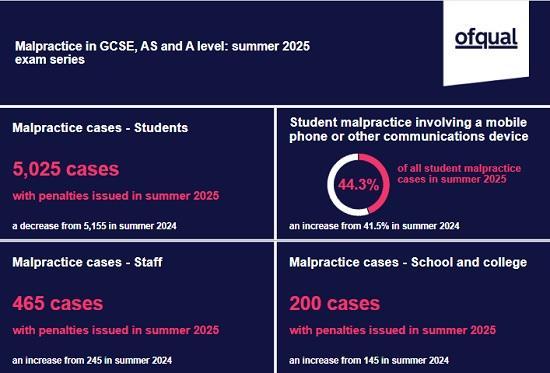
His comments come as Ofqual’s own data showed that mobile phone and smart device offences accounted for 2,225 malpractice cases in the summer 2025 exam series – 44.3% of all student malpractice.
It has been the most common category of student cheating in every summer series since 2018.
Students who take their phones or devices into exam halls risk losing marks or disqualification, preventing them from obtaining a qualification, Sir Ian has warned.
Sir Ian also uses the podcast series’ first episode to speak at length about the future of education and assessment in the age of AI, including the growing difficulties of detecting AI in coursework.
The Can I Just Qualify That? new podcast series will see Sir Ian and Ofqual colleagues explore and explain the world of qualifications and assessment.
The first episode of the podcast will drop on Thursday 4 June at 7:00am. You can listen on YouTube
or through your chosen podcast streaming service
Is there malpractice reporting in Scottish exams?
Yes. Scotland’s qualifications system (now run by Qualifications Scotland, previously the SQA) publishes annual malpractice reports, covering:
Candidate malpractice (cheating by students)
Centre malpractice (schools/colleges or staff issues)
Investigations across National 5, Higher, Advanced Higher and vocational qualifications
These reports are broadly equivalent to Ofqual’s statistical releases for England.
For example, recent Scottish reports show:
Hundreds of confirmed malpractice cases each year
Rising use of mobile phones and AI-assisted plagiarism
Increasing concerns about staff or school-level malpractice in some centres
What counts as malpractice in Scotland?
Scottish exam rules define malpractice very similarly to England. It includes:
Copying or cheating in exams
Plagiarism (including AI-generated work)
Bringing in unauthorised devices (phones, smartwatches)
Collusion between students
Staff altering or improperly influencing assessment outcomes
Poor exam security or incorrect marking processes
So the framework is essentially aligned with England’s system.
What recent Scottish reports show
The most recent data highlights:
Around 200+ confirmed student malpractice cases per year
A rise in cheating involving AI tools and mobile phones
A noticeable increase in concerns about staff or centre-level malpractice
But also: the scale remains small relative to ~130,000+ candidates annually
In other words: malpractice exists, but it is still statistically a small proportion of overall exams.
Key difference vs Ofqual (England)
The main difference is not the existence of malpractice reporting — it’s how it is framed:
England (Ofqual)
Highly statistical, exam-board-driven reporting
Detailed breakdowns per qualification type (GCSE, A-level)
Strong focus on enforcement and penalties
Scotland (Qualifications Scotland / SQA system)
More emphasis on integrity and centre responsibility
Separate reporting for candidate vs centre malpractice
More narrative reporting alongside statistics
So is Scotland “better” or “worse”?
There is no clear evidence that one system has more malpractice than the other.
What can be said fairly is:
Both systems identify similar types of cheating (phones, plagiarism, AI use)
Both report relatively low incidence compared to total exam entries
Both have seen rising concern about technology-enabled malpractice
Both increasingly focus on school/centre responsibility as well as student behaviour
Bottom line
Yes — Scotland absolutely does publish malpractice reports, and it is actively monitoring and investigating the same kinds of issues as Ofqual in England.
But the numbers remain relatively small, and the headline story is less about a “crisis” and more about how exam systems are adapting to:
AI tools
mobile phones
online assessment environments
and tighter scrutiny of school-based marking