Could Scotland Put Data Centres Under the Sea? A Scottish Take on China’s Lingang Experiment
12th June 2026
the technology exists and China has already built commercial underwater data centres that use seawater cooling and offshore wind. But Scotland faces distinct geographic, regulatory and economic hurdles that make the idea promising in theory but challenging in practice.
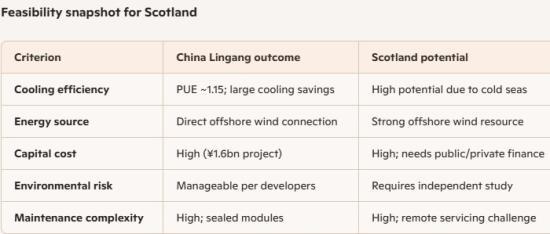
The world’s first large‑scale offshore wind‑powered underwater data centre began commercial operation off Shanghai in 2026. That Lingang project is reported as a 24 MW facility sited beneath the surface and paired with nearby offshore wind turbines; developers claim a low Power Usage Effectiveness (PUE) near 1.15 and substantial reductions in mechanical cooling and freshwater use compared with land sites.
For Scotland the attraction is obvious. Our long coastline, strong offshore wind resource and cool seawater could, in principle, deliver the same benefits: lower energy for cooling, reduced freshwater demand, and a tighter coupling between renewable generation and compute loads. Coastal sites could also relieve pressure on scarce land and avoid some planning conflicts that large onshore data centres provoke.
But the practical barriers are significant. The Chinese projects benefited from concentrated industrial backing, state coordination, and proximity to massive AI demand centres; they were built as integrated demonstrations with heavy public and private investment. Scotland would need comparable capital, subsea engineering expertise, and long‑term commercial customers willing to accept different maintenance and latency profiles. The Lingang modules are sealed, nitrogen‑filled capsules designed for years of autonomous operation — a design that raises replacement and repair costs and requires new logistics for hardware refresh and failure recovery.
Environmental and regulatory scrutiny would also be more intense here. Subsea heat discharge, potential impacts on marine life, seabed disturbance during installation, and fisheries interactions all demand independent environmental assessment and long‑term monitoring. Chinese developers argue risks are manageable, but independent, peer‑reviewed studies and local stakeholder consent would be essential before any Scottish deployment.
Economics will be decisive. The Lingang project cost around ¥1.6 billion (about US$226–230m) for its initial phases; Scotland would need to weigh that capital outlay against savings from reduced cooling and the value of matching compute demand to offshore wind output. Grid connection, subsea cable costs, and insurance for novel subsea infrastructure could erode the operational savings unless projects are scaled and clustered.
Scotland could build subsea data centres, and the technical case is credible. The decision would hinge on finance, environmental safeguards, industrial partners, and a clear market for the compute. If policymakers want to explore it, the sensible next steps are targeted feasibility studies, independent environmental impact assessments, and pilot projects that test maintenance logistics and total cost of ownership in Scottish waters.