1993 vs 2026: How the Cost of Living Has Changed Since Council Tax Began
17th June 2026
When Council Tax was introduced in April 1993, few people imagined it would still be funding local government more than thirty years later.
Britain was a very different country.
The internet was still in its infancy.
Mobile phones were expensive and relatively rare.
Online shopping barely existed.
The average house cost less than £60,000, and many people still paid for goods by cheque.
Thirty-three years later, almost every aspect of our financial lives has changed.
The latest Scottish Government Council Tax statistics prompted me to look back and ask a simple question.
How has the cost of living changed since Council Tax first arrived?
The answers are fascinating.
The exact figures vary depending on location and the source used, but the overall trend is unmistakable.
Life has become much more expensive.
House Prices Have Changed Beyond Recognition
Perhaps the biggest transformation has been the housing market.
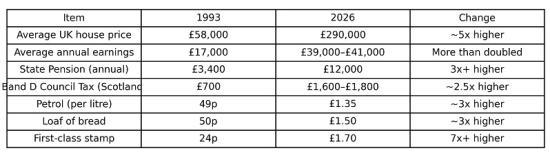
In 1993, the average home cost around £58,000.
Today, it is close to £290,000 across the UK.
In many parts of southern England, average prices are considerably higher.
For first-time buyers, saving for a deposit has become one of the greatest financial challenges they will ever face.
Yet many existing homeowners have seen the value of their properties rise substantially over the past three decades.
Wages Have Risen – But So Have Expectations
Average earnings have more than doubled since Council Tax was introduced.
That sounds impressive.
However, many essential household costs have increased at a similar pace—or even faster.
Housing.
Childcare.
Insurance.
Energy.
Transport.
Food.
Many families therefore feel no better off than previous generations despite earning much higher salaries.
The State Pension Has Changed
Pensioners have also experienced significant change.
The introduction of the Triple Lock has helped the State Pension grow more quickly than inflation during many years.
As a result, today's pension is worth substantially more than it was in the early 1990s.
For many retired households, this has provided important protection during periods of rising prices.
Council Tax – A Different Story
Council Tax itself tells an interesting story.
Many people believe it has risen relentlessly every year.
In Scotland, that is not entirely true.
Long periods of council tax freezes meant bills remained unchanged for almost a decade after 2008, followed by another national freeze in 2024–25.
However, those freezes did not remove the financial pressures facing councils.
They merely postponed them.
When the freezes ended, many councils introduced larger increases to catch up with rising costs.
For households, those sudden jumps often felt much more painful than a series of smaller annual rises would have done.
One Thing Has Never Changed
Perhaps the most surprising fact is this.
Although almost everything else has changed dramatically since 1993, Council Tax is still based on property values from 1991.
Think about that for a moment.
A house valued in 1991 could now be worth four or five times as much.
Yet its Council Tax band remains exactly the same.
Very few people would design a modern tax system in that way.
Successive governments have promised reform.
None has been willing to grasp the political nettle.
The Challenge Facing Councils
The pressure on councils has increased enormously.
They are caring for an ageing population.
Supporting children with additional needs.
Maintaining roads.
Collecting waste.
Managing parks.
Running libraries.
Protecting vulnerable adults.
Providing emergency planning.
Looking after thousands of other local services that many of us take for granted.
All of these services cost significantly more than they did in 1993.
That helps explain why councils argue they need additional funding almost every year.
A Tax Designed for Another Era?
Perhaps the biggest lesson from comparing 1993 with 2026 is not that Council Tax has become unaffordable.
It is that the world around it has changed beyond recognition.
Technology has transformed how we work.
The population has aged.
Property markets have been reshaped.
Consumer expectations have changed.
Public services have expanded.
Yet the basic structure of Council Tax remains largely frozen in time.
The latest Council Tax collection figures show that most people continue to pay their bills.
That is encouraging.
But they also raise a broader question.
Can a tax designed more than thirty years ago continue meeting the needs of modern Scotland?
Or is the country approaching the point where another major reform of local government finance becomes unavoidable?
History teaches us that no tax system lasts forever.
Council Tax replaced the Poll Tax because the previous system no longer commanded public confidence.
Thirty-three years later, perhaps the debate should not simply be about how much Council Tax should increase each year.
Perhaps it should be about whether a funding system based on 1991 property values is still the right one for the Scotland of 2026.