The Great High Street Transformation – Who Disappeared, Who Survived and What Our Town Centres Look Like Today
20th June 2026
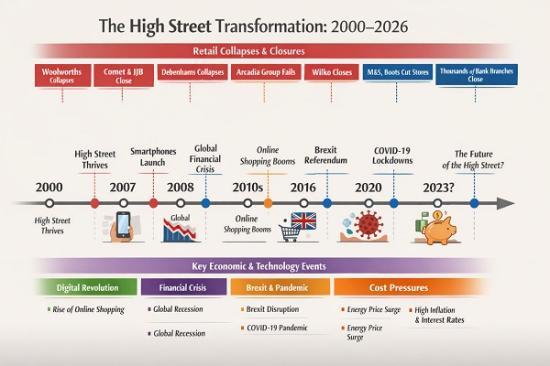
Walk through almost any town or city today and one thing quickly becomes apparent.
The high street is not the place it was at the turn of the century.
Some of Britain's best-known retailers have disappeared altogether. Others are still with us but have closed hundreds of stores. Banks have withdrawn from many communities, while cafés, discount retailers, health services and beauty businesses have become increasingly common.
This is not simply a story of shops closing.
It is a story of how our town centres have been transformed by changing technology, consumer habits and the wider economy.
The Retailers That Disappeared
Many household names that once dominated Britain's shopping streets have vanished.
Among them are:
Woolworths
BHS
Debenhams
Wilko
Comet
Toys R Us (UK stores)
Beales
MFI
C&A
Littlewoods high street stores
The collapse of the Arcadia Group also led to the disappearance of familiar names including:
Burton
Dorothy Perkins
Evans
Wallis
Miss Selfridge
Each business had its own story.
Some struggled with growing debts.
Some failed to adapt to online shopping.
Others found it increasingly difficult to compete in a changing retail market.
The Retailers That Survived—But Became Much Smaller
Not every well-known retailer disappeared.
Many remain successful businesses but operate far fewer stores than they once did.
Examples include:
Marks & Spencer – closed many traditional town-centre stores while investing in larger food halls and retail parks.
Boots – hundreds of branches have closed as part of a long-term restructuring.
WHSmith – reduced its High Street presence while expanding in airports, railway stations and hospitals.
Argos – most standalone stores have disappeared, with many relocated inside Sainsbury's supermarkets.
Next – fewer traditional stores but continued investment in online retail and retail parks.
Currys – rationalised stores as shopping habits changed.
Halfords – reduced some stores while expanding vehicle servicing.
HMV – returned after administration with a much smaller estate.
Monsoon and Accessorize – both continue trading with fewer stores.
Game – far fewer standalone stores than in its peak years.
Mothercare – no longer has UK high street stores but continues as an online and international brand.
Paperchase – stores closed, although the brand continues under new ownership.
For many retailers, survival has depended on adapting rather than simply carrying on as before.
The Banking Retreat
Retail has not been the only sector to shrink its presence.
Banks and building societies have also dramatically reduced their branch networks.
Among those closing large numbers of branches are:
Barclays
HSBC
NatWest
RBS
Lloyds Bank
Bank of Scotland
Halifax
Santander UK
TSB
Nationwide Building Society
Since 2015, more than 6,000 UK bank and building society branches have closed.
Banking hubs are beginning to replace some branches, but many towns—particularly in rural Scotland—have lost face-to-face banking altogether.
If You Returned From the Year 2000…
Imagine someone who last visited a British high street in the year 2000 returning today.
What would they notice?
They would see much less of:
Department stores
Bank branches
Building societies
Electrical retailers
Music and DVD shops
Travel agents
Toy shops
Specialist computer shops
They would see much more of:
Coffee shops
Restaurants and takeaways
Charity shops
Discount retailers
Convenience supermarkets
Vape shops
Beauty salons and nail bars
Gyms and fitness studios
Health clinics
Mobile phone shops
Parcel collection points
The purpose of many town centres has quietly shifted.
Shopping is no longer the only reason people visit.
Why Has This Happened?
No single factor explains the transformation.
Instead, several powerful trends have combined.
Online Shopping
Consumers can compare prices instantly, shop from home and receive rapid delivery.
Retailers have had to compete not just with neighbouring shops, but with businesses across the world.
Rising Business Costs
Retailers have faced higher:
wages;
employer National Insurance contributions;
energy bills;
insurance costs;
rents;
borrowing costs; and
business rates in many locations.
Businesses with small profit margins have been especially vulnerable.
Changing Consumer Behaviour
Many shoppers now value convenience above all else.
They often research products online before buying, expect flexible delivery options and make fewer routine visits to traditional shopping streets.
The Pandemic
COVID-19 accelerated changes that were already under way.
Millions of people who had rarely shopped online before 2020 became regular online customers.
Many have never fully returned to previous shopping habits.
Scotland's Particular Challenge
Scotland shares many of these trends, but geography creates additional pressures.
Longer travel distances, smaller local markets and higher transport costs can make it harder for independent businesses to thrive, particularly in rural areas and the Highlands and Islands.
The loss of even one major retailer or bank branch can have a much greater impact on a small town than it would in a large city.
Is the High Street Dying?
Not necessarily.
It is changing.
Many town centres are becoming places where people:
meet friends;
eat and drink;
access healthcare;
visit gyms;
use community services;
collect online purchases; and
increasingly live, as former retail premises are converted into housing.
The challenge is ensuring that this transition creates vibrant town centres rather than rows of empty shops.
It is easy to look back with nostalgia at the high street of twenty-five years ago.
Many familiar names have gone, and some communities have undoubtedly lost valuable services.
But history shows that town centres have always evolved.
Markets became shopping streets.
Shopping streets became retail destinations.
Now retail destinations are becoming mixed-use centres combining shopping, leisure, healthcare, housing and community services.
The real question is not whether our high streets have changed—they clearly have.
The question is whether we can shape that change in a way that keeps our towns economically vibrant and socially connected.
Food for Thought
Perhaps we should stop asking:
"How many shops have closed?"
Instead, perhaps we should ask:
What do we want our town centres to be in 2035?
How can independent businesses compete in the digital age?
Should business rates be reformed?
Can vacant buildings be brought back into productive use?
How do we preserve essential services, such as banking, in smaller communities?
The high street of the future is unlikely to look like the high street of the past.
But with the right choices, it can still be at the heart of our communities.